

Are Cargo Vans Reliable with High Mileage?

Cargo vans can often stay reliable past 150,000 miles if service records are complete and major wear items were repaired on schedule. Skipped maintenance turns cheap mileage into expensive downtime, and transmission, suspension, brake, and cooling repairs often cost more than the van’s remaining value. This guide shows how to judge high-mileage vans by use history, maintenance proof, and the repairs most likely to surface next.
Why service records matter more than mileage

High mileage alone does not decide reliability. A cargo van with complete fleet records, regular fluid changes, and a light-duty life can be a sound buy, while a lower-mileage van with skipped services and hard hauling may be the riskier choice. Mileage matters most when it lines up with wear, rust, and repair history.
Cargo vans are built for enclosed hauling, with rear and side-door access that suits urban and suburban work. They are meant to balance cargo capacity and maneuverability, so their usable life depends heavily on how much weight they carried, how often they idled, and whether maintenance stayed on schedule.
Why mileage alone is not the full answer
Two vans with the same odometer reading can age very differently. One may have been part of a fleet with scheduled service, documented repairs, and predictable duty cycles. Another may have spent its life overloaded, short-tripped, and serviced only after a warning light came on.
The second van can fail sooner even at a lower number. That is why body condition, starting behavior, shift quality, and service paperwork should come before mileage in the buying decision.
Why maintenance history changes the risk
Maintenance records matter because they show whether the expensive wear items were handled before they cascaded into bigger faults. Fluid changes, brake work, cooling-system service, and transmission repairs all change the odds of a costly surprise.
Export-Seller notes that high-mileage vans used in professional fleet service can still be good value, and that engine and gearbox condition are among the most important purchase checks. That lines up with the practical rule here: condition and service proof outrank odometer reading alone.
Cargo van mileage matrix
This decision matrix separates mileage bands by use history and evidence. Treat it as a buy/no-buy filter, not a price guide. The same odometer reading means less on a fleet-serviced van with clean records than on a neglected private-use van with missing receipts.
| Mileage band | Use history | Maintenance evidence | Likely wear items | Red flags | Verdict |
|---|---|---|---|---|---|
| 100k miles | Light fleet use or careful private use | Oil changes, brake work, and cooling service documented | Bushings, brakes, battery, tires, door rollers, minor seepage | Hard starting, rough idle, transmission flare, rust at seams | Buy if records are complete and the van drives cleanly |
| 150k miles | Best case is fleet-serviced and lightly loaded | Proof of transmission service, coolant work, and major wear items | Suspension, cooling parts, mounts, sensors, wheel bearings | Warning lights, delayed shifts, fluid leaks, heavy corrosion | Buy only with strong records and a clean inspection |
| 200k+ miles | Only strong candidates are documented fleet vans with steady upkeep | Long service trail with no gaps in major repairs | Transmission, steering, cooling, rust repair, door hardware | Unknown history, worn gearbox, poor idle, structural rust | Usually no-buy unless price is very low and condition is exceptional |
| Gas vs diesel | Gas often fits lower-cost local duty; diesel suits heavier hauling and longer runs | Diesel needs proof of its specific maintenance items | Gas: ignition and fuel system wear; diesel: fuel, emissions, turbo, and related service | Missing diesel maintenance, repeated fault codes, or neglected service intervals | Choose by use case, service proof, and repair budget |
100k miles: what is usually acceptable
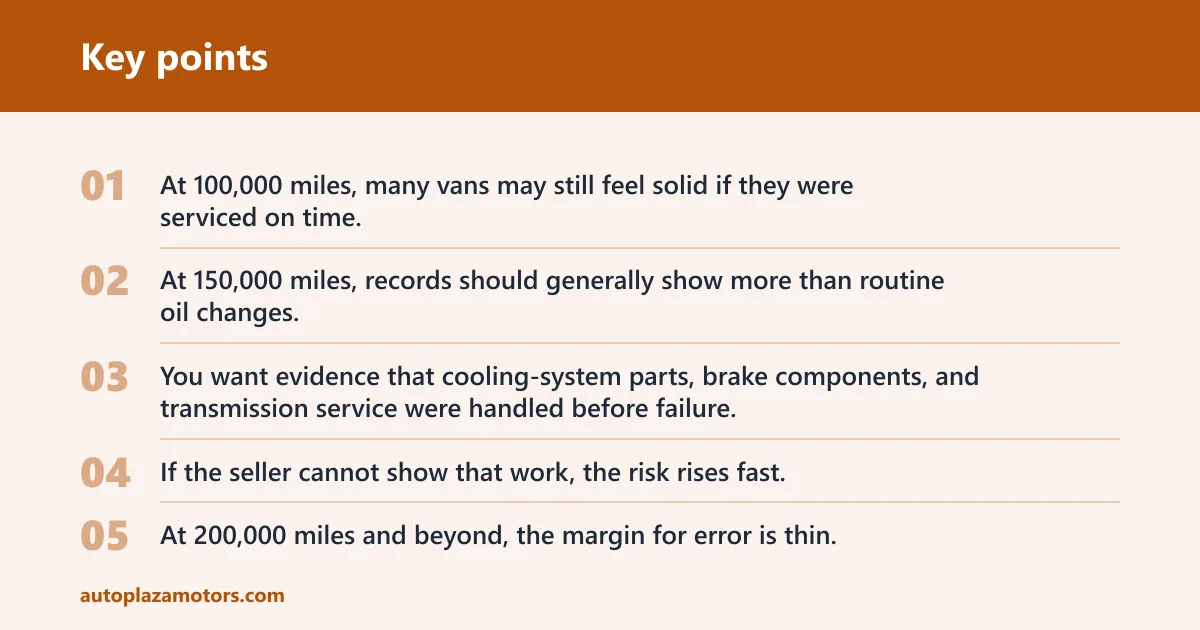
At 100,000 miles, many vans may still feel solid if they were serviced on time. A clean start, stable idle, normal shift quality, and a body without major rust usually matter more than the number itself. This is also where proof of regular upkeep should be easy to produce.
150k miles: what needs proof
At 150,000 miles, records should generally show more than routine oil changes. You want evidence that cooling-system parts, brake components, and transmission service were handled before failure. If the seller cannot show that work, the risk rises fast.
200k+ miles: when to walk away
At 200,000 miles and beyond, the margin for error is thin. The van can still be usable, but only if the drivetrain is quiet, the gearbox shifts cleanly, corrosion is limited, and the paper trail is strong. Unknown history at this level is usually a deal-breaker.
Gas vs diesel mileage guidance
Diesel engines are generally more fuel-efficient than gas counterparts, and diesel trucks typically offer better mileage and longer driving ranges. They also offer greater towing and hauling capability. That makes diesel a better fit for heavier work, but it usually comes with higher initial cost and specific maintenance requirements.
Gasoline trucks generally have a lower upfront cost than diesel trucks. That lower purchase price can help if the van will cover local routes, short hauls, and lighter duty. The tradeoff is fuel economy, which usually lags diesel.
What to inspect first on an older van
Start with the drivetrain, then move to the body and the systems that turn mileage into repair bills. Engine and gearbox condition, rust, suspension wear, cooling performance, and warning lights are the fastest way to separate a healthy van from a tired one. A cheap van with a bad gearbox is rarely cheap for long.
-
Check start and idle behavior.
Look for easy starting, even cold and warm, with no extended cranking, knocking, or hunting idle. A rough idle can point to fueling, ignition, vacuum, or compression trouble that may become expensive quickly. -
Test shift quality.
Drive at low and moderate speeds and note whether shifts are smooth, timely, and free of flare, slip, or harsh engagement. Delayed or erratic shifting is one of the clearest signs that the gearbox may be near a major repair. -
Inspect rust and structure.
Check the floor, wheel arches, lower doors, seams, and underbody. Surface corrosion is common; structural rust around mounts, sills, or suspension points is a much bigger problem. -
Examine cooling parts.
Look for coolant stains, crusty residue, swollen hoses, weak fans, and signs of overheating. Cooling faults can destroy an engine even when the van still starts and drives. -
Open and close every door.
Side and rear doors should latch cleanly, slide or swing without binding, and show no major sag. Door hardware wear matters more on cargo vans because the body is used as a work tool, not a private car shell.
Say your candidate is a 150,000-mile van with clean body panels but a transmission that flares on the 2-3 shift. Even with complete service records, that shift pattern should weigh heavily against the deal, because gearbox repair risk can exceed the van’s value quickly.
Suppose another van shows 180,000 miles, starts instantly, idles smoothly, and has fleet records for oil, coolant, and brake service. If the underbody is clean and the doors still latch firmly, the mileage is less alarming than a vague 110,000-mile van with no paperwork.
What maintenance records matter most?
The best records are complete, dated, and specific. They should show routine service, major wear-item replacement, and repairs that match the van’s duty cycle. Gaps in the paper trail matter because they hide neglect, deferred work, and repeated faults that may return soon.
Fleet service documentation
Fleet records are especially useful because they usually track repeat service intervals and repair history. Export-Seller specifically points to professional fleet service as a reason some high-mileage vans remain good value. A van with clear fleet paperwork is easier to judge than one with only a handwritten oil sticker.
Wear items replaced on schedule
The most useful records show brake service, coolant service, transmission work, belts, hoses, filters, and battery replacement. Those items wear out in a predictable way. If they were replaced on schedule, the van is more likely to have been maintained before failures spread.
Gaps that raise the risk
Watch for missing service years, vague invoices, repeated overheating, or no proof of drivetrain work on a high-mileage van. Missing records do not prove neglect, but they remove the evidence needed to justify a higher-mileage purchase.
How do you tell if a van was in fleet service?
Fleet use often leaves clues in the paperwork, the interior, and the body. It is not always bad news. A well-run fleet can be better documented than a private van. The key is to separate steady maintenance from hard duty and patchwork repairs.
Record clues
Look for repeated service entries at regular intervals, repair orders from the same commercial shop, and notes about scheduled inspections. Large fleets often keep more complete history than private owners do, which helps you judge whether mileage was managed or merely accumulated.
Interior and body clues
Fleet vans often show uniform wear on the driver’s seat, step plates, cargo floor, and door handles. Paint touch-ups, labeled panels, racks, partitions, and holes from removed equipment can also point to commercial use. None of these are automatic deal-breakers, but they help explain the van’s life.
Signs of heavy use versus light use
A light-use fleet van may have a tidy cargo area, regular maintenance, and modest body wear. Heavy-use examples often show dented door edges, scuffed thresholds, sagging hinges, and tired suspension. Heavy use without matching records is the combination that should raise the most concern.
Which cargo van is the most reliable?
There is no single most reliable cargo van in every case. The safer answer is the van with the best service history, cleanest drivetrain behavior, and least structural wear. Model reputation matters, but condition and use history outrank badge loyalty on the used market.
How to compare models without relying on mileage alone
Compare vans by service proof, gearbox behavior, rust, and the likely cost of fixing known wear items. A lower-mileage van with poor evidence can be worse than a higher-mileage van with fleet documentation and steady repairs. The odometer is only one part of the picture.
Gasoline versus diesel reliability tradeoffs
Diesel can make sense for heavier loads, longer routes, and buyers who want the stronger hauling side of the market. But diesel also brings higher purchase price and more specific maintenance needs. Gasoline vans often cost less up front and can be easier to justify for lighter urban use.
Why condition and use history outrank badge loyalty
A clean, fleet-serviced van from an ordinary model can outlast a premium badge that was run hard and ignored. Reliability in the used market is a record-keeping problem as much as a design problem. The best van is the one with proof.
How many miles is too many for a used cargo van?
There is no universal cutoff, but many owners report the risk curve starts to change after 100,000 miles, becomes sharper after 150,000 miles, and gets much steeper at 200,000 miles and beyond. At each point, the question shifts from “how many miles?” to “what has already been replaced, and what is next?”
Where the risk curve changes
After 100,000 miles, wear items start to matter more than cosmetic condition. After 150,000 miles, drivetrain and cooling history matter most. Past 200,000 miles, the odds of expensive repairs rise enough that only the strongest examples deserve serious consideration.
When mileage becomes a deal-breaker
Mileage becomes a deal-breaker when it comes with missing records, warning lights, transmission problems, rust in the structure, or signs of overheating. Any one of those can outweigh a lower price. A cheap van that needs a gearbox is not a bargain.
When a high-mileage van can still be a buy
A high-mileage van can still be a buy when the records are complete, the engine starts cleanly, the gearbox shifts well, the body is sound, and the van was used in a controlled fleet environment. That combination can make 150,000 miles feel less risky than a neglected van with far fewer miles.
Frequently asked questions
Are cargo vans reliable with high mileage?
Yes, they can be. Reliability depends more on maintenance quality, use history, and repair timing than on mileage alone. A fleet-serviced van with clean records and light loading can stay dependable well past 150,000 miles, while a neglected van can become costly long before that.
What problems happen most often in high-mileage cargo vans?
The most common trouble spots are transmission wear, suspension looseness, cooling-system faults, rust, and door hardware problems. Engine starts, idle quality, shift behavior, and warning lights are often the earliest signs that those systems are getting expensive.
Can a high-mileage cargo van still be a good buy?
Yes, if the van has complete records, a clean body, a strong engine and gearbox, and evidence that major wear items were handled on schedule. The best high-mileage buys are usually fleet-serviced vans with predictable use and documented repairs.
What maintenance records matter most on a used cargo van?
Look for dated oil changes, coolant service, brake work, transmission service, belt and hose replacement, and any repair orders tied to warning lights or overheating. Complete records matter because they show whether the van was maintained before wear became failure.