
High Mileage SUV: When to Buy and When to Walk Away

Buy a high-mileage SUV only when roughly 100,000 to 150,000 miles comes with dated service records showing oil changes and major fluid work, clean inspection results with no active fault codes or cooling or transmission warnings, and a repair budget; walk away at any mileage if maintenance gaps, rust, transmission issues, or overheating appear. Get this wrong, and a cheap SUV can turn into roughly several thousand dollars in near-term repairs or repeated downtime. This guide lays out mileage thresholds, service-history clues, inspection red flags, and repair-cost cutoffs that separate a smart buy from a money pit.
Mileage matters, but it is only one input. The better filter is this: decide whether the miles reflect normal wear that is already priced in, or whether they point to failure risk the asking price does not cover.
What counts as high mileage on an SUV?
High mileage on a used SUV often starts once the odometer reaches about 100,000 miles, but the better benchmark is miles compared with age, annual use, and maintenance. An SUV with steady annual use, matching wear, and solid records can be lower risk than an older low-mile example with gaps, short-trip use, or visible wear that does not fit the odometer.
Absolute miles versus miles per year
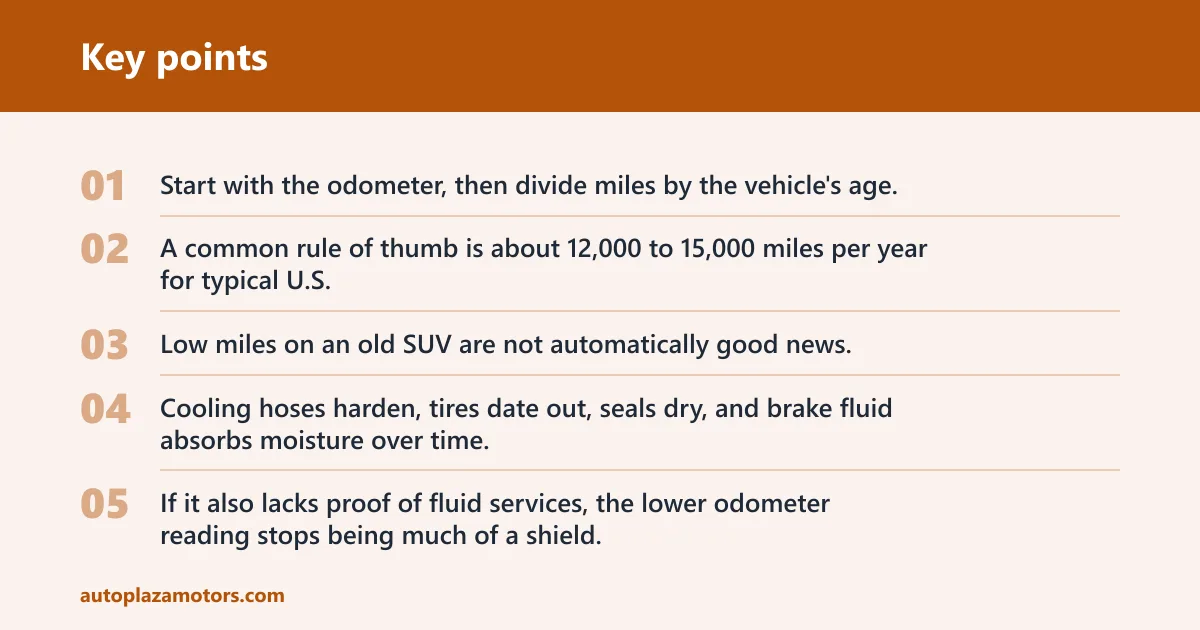
Start with the odometer, then divide miles by the vehicle’s age. A common rule of thumb is about 12,000 to 15,000 miles per year for typical U.S. use. That makes 120,000 miles on a 10-year-old SUV fairly ordinary, while 120,000 miles on a 5-year-old one calls for closer scrutiny of use and maintenance.
That annual average changes the meaning of the same odometer reading. A 130,000-mile commuter that spent most of its life on interstates may have fewer cold starts, fewer hard stops, and less suspension abuse than a 90,000-mile city SUV used for school runs, curb impacts, and stop-and-go traffic.
Why age can matter more than the odometer
Low miles on an old SUV are not automatically good news. Rubber ages even when a vehicle sits. Cooling hoses harden, tires date out, seals dry, and brake fluid absorbs moisture over time.
An older SUV with 60,000 miles may still need tires, a battery, brake work, suspension bushings, and a cooling-system refresh. If it also lacks proof of fluid services, the lower odometer reading stops being much of a shield.
When visible wear does not match the stated mileage
Check whether the cabin and cargo-area wear fit the mileage claim. Heavy smoothing on the steering wheel, polished pedals, split driver-seat bolsters, or deep cargo-floor scratches can signal harder use than the listing suggests.
Wear consistency matters more than cosmetics alone. Light seat wear on a highway family hauler is normal. Severe pedal wear, chipped interior switches, and a sagging driver’s seat on a supposedly low-mile SUV deserve extra questions and a VIN-based history review.
Suppose a 9-year-old SUV shows 72,000 miles, but the driver’s seat cushion is collapsed, the steering wheel is shiny and thin at the top, and the cargo floor is heavily gouged. That does not prove odometer trouble, but it does mean the claimed mileage should no longer be trusted without stronger records.
When is a high-mileage SUV still worth buying?

A high-mileage SUV is still worth buying when the miles came from steadier use such as commuting or long highway trips, the records include dated proof of oil changes plus major fluid and wear-item service, the inspection finds no active driveline, rust, or cooling faults, and the price leaves room for normal wear items. In that case, mileage can create a discount without creating immediate major-system risk.
Documented maintenance that lowers risk
Service records should show more than oil changes. Look for oil-change intervals that were regular, not stretched without explanation. Also look for proof of spark plugs, coolant service, brake-fluid service, transmission fluid service, and AWD fluid service where equipped.
Timing components matter too. If the engine uses a timing belt, proof of belt service is a strong value marker. If it uses a timing chain, listen for cold-start rattle and review oil-change history carefully, because poor lubrication maintenance can shorten chain and tensioner life.
Why highway-heavy use can be easier than city use
Highway miles are usually easier than city miles because a vehicle at steady speed spends less time heat-soaking in traffic, makes fewer full stops and 1-2 upshifts, and puts less repeated load on brakes, front suspension joints, and the transmission than an SUV used for short errands and stoplight traffic. That does not erase wear, but it often changes the wear pattern from severe to manageable.
Usage profile should be part of every decision. A commuter or road-trip SUV may wear differently from a family hauler that spent years on short trips. A city fleet vehicle can have modest mileage yet high idle time, rough curb encounters, and more suspension damage than the odometer suggests.
Price discount versus expected repair budget
High mileage only creates value when the discount is larger than the likely repair bill. If a 140,000-mile SUV is priced only slightly below cleaner lower-mile examples, there is little reason to absorb the extra risk.
Plan for the first year. Tires, brakes, shocks or struts, battery, alignment work, and cooling-system parts often decide whether the deal makes sense. If the SUV is AWD, add possible transfer-case, differential, driveshaft, or coupler service to that budget.
Picture two similar midsize SUVs. One has 128,000 highway miles, stack-of-paper records, recent tires, and documented transmission and differential service. The other has 96,000 city miles, no records, mismatched tires, and a harsh 2-3 shift. The first one can be the safer buy even with the bigger number on the dash.
When should you walk away?
You should walk away when missing records combine with signs of major-system stress, especially overheating history, rust in structural or suspension areas, transmission faults, or AWD binding and noise. A low price rarely fixes those risks because the repair path is expensive, uncertain, and easy to underestimate.
Missing records plus major-system warning signs
Missing records do not automatically kill a deal. Missing records plus neglected fluids, warning lights, and seller answers that do not line up with the vehicle’s condition usually should.
If the check-engine light is on, scan for codes before any price discussion. If readiness monitors are unset right after a seller says the light was “nothing,” assume more inspection is needed. Freshly cleaned engine bays, low coolant, and burnt-smelling transmission fluid are all reasons to slow down or stop.
Red flags in the engine, transmission, or cooling system
Listen on a cold start. Rattle, heavy ticking, smoke, rough idle, or a flashing misfire light point toward real risk. Check for coolant crust around the radiator, water pump area, hose junctions, and expansion tank.
On the drive, delayed engagement when shifting into drive or reverse, flares between gears, harsh downshifts, or shudder under light throttle are expensive signs. Any hint of repeated overheating is serious because one event can damage head gaskets, warp components, and shorten transmission life.
AWD problems that turn a cheap SUV into an expensive one
AWD complexity is where many cheap SUVs stop being bargains. Transfer cases, differentials, couplers, driveshaft joints, and wheel-speed-related control issues add repair layers that a two-wheel-drive version simply does not have.
Watch for mismatched tire brands or sizes, uneven tread depth, humming on deceleration, clunks on takeoff, and binding during tight low-speed turns in a parking lot. Those signs can point to driveline stress or neglected AWD maintenance.
A common first-timer mistake is seeing an AWD badge as pure upside. On a high-mileage SUV, AWD only helps if the service history is there and all four tires match closely enough to avoid driveline strain.
SUV decision table
| Mileage band | What to check first | Common near-term risk areas | Buy / negotiate / walk away trigger |
|---|---|---|---|
| Under 80,000 miles | Age versus miles, tire age, brake condition, scan for codes, service record consistency, wear on seats and pedals versus odometer | Battery, tires, brakes, early suspension wear, deferred fluids, old coolant and brake fluid on low-use vehicles | Buy if records are consistent and inspection is clean. Negotiate for aged tires, due fluids, or minor suspension wear. Walk away if wear is inconsistent with mileage, rust is serious, or there are transmission or overheating signs. |
| 80,000-120,000 miles | Oil-change intervals, spark plugs, transmission service, cooling-system condition, shocks/struts, bushings, wheel bearings, AWD fluid history | Suspension refresh, tires and alignment, cooling leaks, oil leaks, brake work, first round of AWD service neglect showing up | Buy if maintenance is documented and road test is clean. Negotiate when tires, brakes, struts, or fluid services are due. Walk away if service history is missing and the SUV also has harsh shifting, driveline vibration, or coolant loss. |
| 120,000-150,000 miles | Transmission shift quality, cold-start behavior, undercarriage leaks, cooling fan operation, control arms, tie rods, transfer case and differential service, matching tires | Transmission wear, steering play, wheel bearings, control-arm bushings, radiator and water-pump work, driveshaft or coupler wear | Buy only if records are unusually complete and the discount is meaningful. Negotiate for normal wear items with clear estimates. Walk away if missing records combine with oil consumption, repeated misfire history, delayed engagement, or AWD binding. |
| 150,000 miles and up | Compression or leakdown if symptoms justify it, scan data, rust at mounting points, overheating history, transmission behavior hot and cold, full underbody inspection | Major cooling work, oil leaks, timing-component wear, transmission overhaul risk, differential and transfer-case wear, repeated downtime from stacked small failures | Buy only as a documented, well-priced example with a clean inspection and a real repair reserve. Negotiate if the SUV is fundamentally sound but needs routine wear items. Walk away if any two of these appear together: no records, structural rust, overheating signs, significant transmission fault, heavy oil burning, or AWD noise/binding. |
How should you weigh mileage against service history?
Service history should outweigh mileage when it is detailed, plausible, and covers the systems that actually fail expensively. Mileage should outweigh service history when the records are thin, generic, or skip major fluids and repairs that matter at that stage of the SUV’s life.
Oil changes and engine longevity
Oil-change history is the base layer. Receipts that show regular intervals and the right viscosity matter because they support the condition of timing components, turbo hardware where fitted, and internal engine cleanliness.
A folder full of tire receipts is not the same as real engine care. On a high-mileage SUV, the useful records are the ones that reduce uncertainty about lubrication, cooling, and driveline service.
Transmission, transfer case, and differential service
Transmission and AWD service history often decides the deal. Ask for dated proof, not a verbal “it was done.” If the vehicle has AWD, look for transfer-case and differential fluid service too.
That matters because used-SUV shoppers often compare attractive lists rather than actual risk. TrueCar ranks 20 SUVs by gas mileage for 2026 and 2027, and that kind of page is useful for fuel economy. It is not a buy-versus-walk-away framework for a used high-mileage SUV. A 2027 Kia Niro may be TrueCar’s number one pick, with 49–53 MPG combined, seating for five, front-wheel drive, a hybrid 1.6L I4, 139 horsepower, and a 5-year/60,000-mile basic warranty. Those facts describe a new-vehicle value case, not whether a used 130,000-mile AWD SUV in front of you has an overdue transfer-case service or a failing valve body.
Timing components, cooling-system work, and other major services
Cooling-system history deserves its own check. Radiator, thermostat, water pump, hoses, and coolant exchanges become more important as mileage rises, because heat is what turns manageable wear into engine and transmission damage.
The same goes for timing components where relevant, spark plugs, ignition coils if already replaced, and charging-system work. A record set that covers those items can justify buying an SUV with higher miles than its competitors.
What should a pre-purchase inspection cover?
A pre-purchase inspection should cover scan-tool results, a cold start, a full road test, undercarriage condition, fluid leaks, cooling-system health, suspension wear, brake condition, and AWD operation. On certain older or symptom-heavy SUVs, compression or leakdown testing can be worth the extra cost because it changes the decision.
Scan-tool checks and road-test findings
- Scan all modules. Read current, pending, and stored codes, then check emissions-monitor readiness. A recently cleared system can hide faults long enough to sell the SUV but not long enough to own it without trouble.
- Start it cold. Listen during the first 30 seconds for chain rattle, lifter noise, exhaust leaks, and unstable idle. Cold-start behavior often reveals issues that a warmed-up seller handoff hides.
- Drive at varied speeds. Use city speeds, steady highway speeds, moderate throttle, and parking-lot turns. You are listening for shift flare, driveline vibration, wheel-bearing hum, brake pulsation, and AWD bind.
- Recheck when hot. After the drive, inspect for new drips, coolant smell, fan operation, and delayed restart behavior. Heat can expose seepage and weak components that look fine before the road test.
Undercarriage, leaks, and corrosion
The underbody tells the truth fast. Look at subframes, control-arm mounts, brake and fuel lines, shock bodies, differential housings, axle boots, and exhaust hangers. Surface rust is one thing. Rust at structural points or suspension mounts is another.
Inspect for oil leaks at the valve covers, timing cover area, oil pan, rear main area, and around the transmission case. Check for coolant traces, not only wet leaks. Dried residue can be the clue that matters.
When compression or leakdown testing makes sense
Compression or leakdown testing is not required on every high-mileage SUV. It is worth considering when there is a misfire history, clear oil consumption, smoke on startup, uneven idle, or concern about an older or more stressed engine.
The test makes more sense when the alternative is guessing. If the SUV is already near the top of your budget, spending more to confirm engine health can prevent a much larger mistake.
How to react to strange noises before they become major repairs
Unusual sounds are often the earliest warning that a high-mileage SUV needs attention, and some should be treated as stop-driving-now problems. The supporting guide breaks down which noises signal immediate risk, which ones point to common wear items, and which can usually wait for a scheduled repair. It also helps you tell whether a noise changes with engine speed, road speed, or braking, which makes it much easier to narrow down the source.
If you’re hearing grinding, knocking, whining, or belt squeal, this high-mileage SUV noise guide shows what those sounds usually mean and why acting early can prevent a small issue from turning into a tow or a much larger repair.
Which high-mileage SUV repairs show up most often?
High-mileage SUVs most often need suspension and steering parts, tires and alignment work, cooling-system repairs, oil-leak fixes, brake work, and transmission or AWD attention. The exact list changes by design and use, but these categories drive many first-year ownership costs after a high-mileage purchase.
Suspension, steering, tires, and alignment
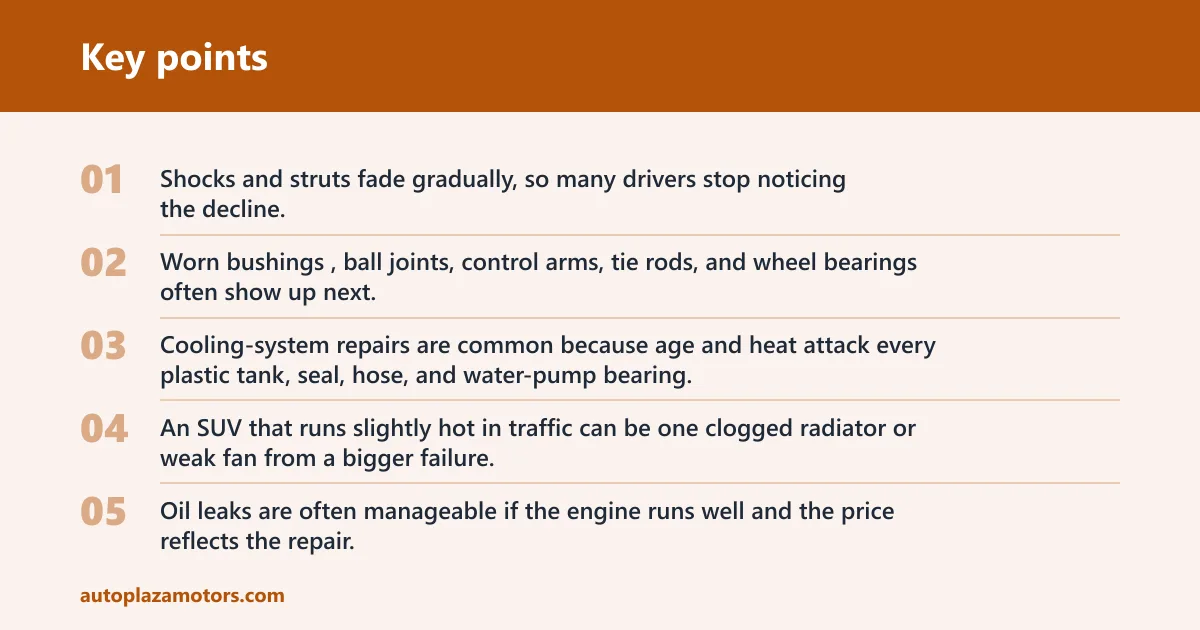
Shocks and struts fade gradually, so many drivers stop noticing the decline. Worn bushings, ball joints, control arms, tie rods, and wheel bearings often show up next. The clue is usually not one loud noise. It is tire feathering, wandering, cupping, uneven brake feel, or repeated alignment issues.
High-mileage SUVs also punish cheap tires. If the vehicle has mismatched brands, uneven wear, or old date codes, budget for replacement soon, especially on AWD models where rolling circumference matters.
Engine, cooling, and oil-leak issues
Cooling-system repairs are common because age and heat attack every plastic tank, seal, hose, and water-pump bearing. Small leaks matter. An SUV that runs slightly hot in traffic can be one clogged radiator or weak fan from a bigger failure.
Oil leaks are often manageable if the engine runs well and the price reflects the repair. They are less manageable when they come with low oil level, visible smoke, active misfires, or oily contamination on cooling hoses and belts.
Transmission and AWD wear points
Transmission issues range from overdue fluid service to internal wear that no additive will fix. Harsh shifts, slipping under load, delayed engagement, and repeated fault codes belong in the high-risk category.
AWD systems add transfer cases, differentials, couplers in some designs, and driveshaft components. The more complex the driveline, the more important it is to avoid “cheap” examples with tire mismatch, fluid neglect, or vibration that the seller calls normal.
For context, new crossovers like the 2026 Lexus UX are sold with an all-wheel-drive hybrid powertrain and are estimated at 44 MPG in the city and 40 MPG on the highway, plus a 4-year/50,000-mile basic warranty. That new-vehicle protection changes the cost picture. A used high-mileage AWD SUV has no such cushion, so driveline condition has to be priced directly into the decision.
Can a high-mileage SUV still be reliable for family use?
A high-mileage SUV can still be reliable for family use if it starts cleanly, runs at stable temperature, shifts correctly, stops straight, has strong tires and brakes, and comes with enough service proof to keep downtime risk low. The family standard is dependability under routine stress, not merely passing today’s test drive.
The reliability standard a family buyer should require
For family duty, the bar is higher than “seems fine.” The SUV should have no active warning lights, no cooling concerns, no fuel-smell issues, no unstable idle, no steering looseness, and no tire or brake compromises. Climate control and charging system health matter too if the vehicle will carry children daily.
How to judge downtime risk versus purchase savings
If the high-mileage discount buys enough room for tires, brakes, a battery, and likely suspension work, the deal can work. If the savings vanish after one repair quote, it was never really cheaper.
Say your budget fits either a simpler front-wheel-drive two-row SUV with 118,000 documented highway miles or a larger AWD three-row with 106,000 miles, no records, and a driveline vibration. For family use, the simpler documented vehicle is usually the safer call because downtime risk matters as much as purchase price.
When a simpler two-row SUV makes more sense
More seats and more driven wheels usually mean more parts, more weight, and more repair paths. If your actual use is school runs, groceries, and weekend trips for four people, a simpler two-row model can be the smarter high-mileage bet.
How to make the buy, negotiate, or walk-away call
The decision should come from the combination of records, inspection, drivetrain complexity, and price gap, not from mileage alone. Buy when the evidence reduces uncertainty, negotiate when repairs are predictable and limited, and walk away when expensive systems show stress that the discount does not realistically cover.
Buy: the conditions that justify moving forward
Buy when the service history includes dated records for oil changes, transmission and cooling service, wear matches the miles, the PPI finds no active codes or major leaks, and the first-year repair budget looks manageable. That is especially true when the use pattern appears highway-heavy and the drivetrain is simpler.
- Records cover oil changes and major fluids.
- No overheating history or transmission complaint appears.
- AWD, if present, operates quietly with matching tires.
- Price leaves room for normal wear items without stress.
Negotiate: defects that should change the price
Negotiate when the faults are real but bounded. Tires near replacement, worn struts, minor oil seepage, due spark plugs, and overdue fluid services are typical examples if the engine, transmission, and cooling system still check out well.
- Treat every due item as cash, not as a vague annoyance.
- Use the PPI list to group immediate repairs versus future maintenance.
- Be stricter on AWD SUVs because small neglect can become a large bill.
Walk away: combinations that usually are not worth the gamble
Walk away when multiple major risks stack together. That includes missing records plus harsh shifting, coolant loss plus any overheating story, or structural rust plus suspension wear. At that point, the problem is not one repair. It is uncertainty across the whole vehicle.
- Set your mileage context. Compare total miles with age and estimated annual use. A steady-use SUV with matching wear starts from a stronger place than an oddly low-mile unit with inconsistent condition.
- Grade the records. Separate complete records, partial records, and no records. Complete means dated proof of oil changes, transmission fluid, coolant, brake fluid, and other relevant components, not just random receipts or handwritten notes.
- Rank system risk. Put engine, cooling, transmission, rust, and AWD at the top because those failures move the decision fastest. Cosmetics and infotainment sit much lower on a high-mileage purchase.
- Price the first year. Add the purchase price to known immediate repairs and a reserve for normal wear. If that total approaches the price of a cleaner lower-risk alternative, walk away.
- Make one call. Buy only if the evidence lines up, negotiate only if the issues are limited and priced correctly, and walk away if two major red flags appear together.
Frequently asked questions
How many miles is too many on a used SUV?
There is no single cutoff, but risk rises sharply once an SUV reaches 120,000 to 150,000 miles without strong records. Past that point, the question is less about the number itself and more about cooling-system health, transmission behavior, AWD condition, rust, and whether maintenance proof is complete.
When is high mileage on an SUV still worth buying?
High mileage is still worth buying when the SUV shows steady use, documented services, clean scan results, stable temperatures, good shift quality, and no major rust or AWD faults. The price also needs to leave room for normal wear items such as tires, brakes, and suspension work.
Should I trust maintenance history more than mileage on a high-mileage SUV?
Yes, if the maintenance history is detailed and covers the systems that matter most: oil changes, transmission service, cooling work, and AWD fluids where equipped. No, if the records are vague, incomplete, or skip major items that should have been addressed by that age and mileage.
What signs mean I should walk away from a high-mileage SUV?
Walk away if you see any combination of missing records, overheating signs, structural rust, harsh or slipping shifts, active warning lights, heavy oil consumption, coolant loss, or AWD binding on tight turns. One concern may be negotiable. Several together usually point to expensive uncertainty.
Is highway mileage better than city mileage on a used SUV?
Usually, yes. Highway miles tend to mean fewer cold starts, fewer hard stops, less idle time, and less repeated low-gear shifting than city use, which is harder on brakes, suspension parts, and automatic transmissions. That said, highway use does not excuse neglected fluids, overheating history, rust, or driveline noise, so the inspection still decides the purchase.
What should I inspect before buying a high-mileage SUV?
You should inspect scan-tool codes, cold-start behavior, transmission shift quality, cooling-system condition, oil and coolant leaks, undercarriage rust, suspension and steering play, tire wear, brake condition, and AWD operation. If misfires, smoke, or oil consumption appear, compression or leakdown testing may be worth adding.