

Why Are High Mileage Trucks So Expensive?
High-mileage trucks stay expensive because mileage is only one part of the asking price; the right cab, bed, drivetrain, and 4×4 setup can keep a pickup desirable long after the odometer climbs. Ignore that, and you can overpay for a truck that looks cheap on paper but costs more to own and resell. This guide explains the market forces behind those prices and how to judge whether a high-mileage truck is still worth it.
Why are high-mileage trucks so expensive?
High mileage usually lowers price, but trucks often hold value better than many cars because buyers still want usable, work-ready pickups with the right configuration. Market demand, body-on-frame durability, and proof of care can keep a truck priced well above a similar-age car with the same odometer reading.
Mileage is only one part of the asking price
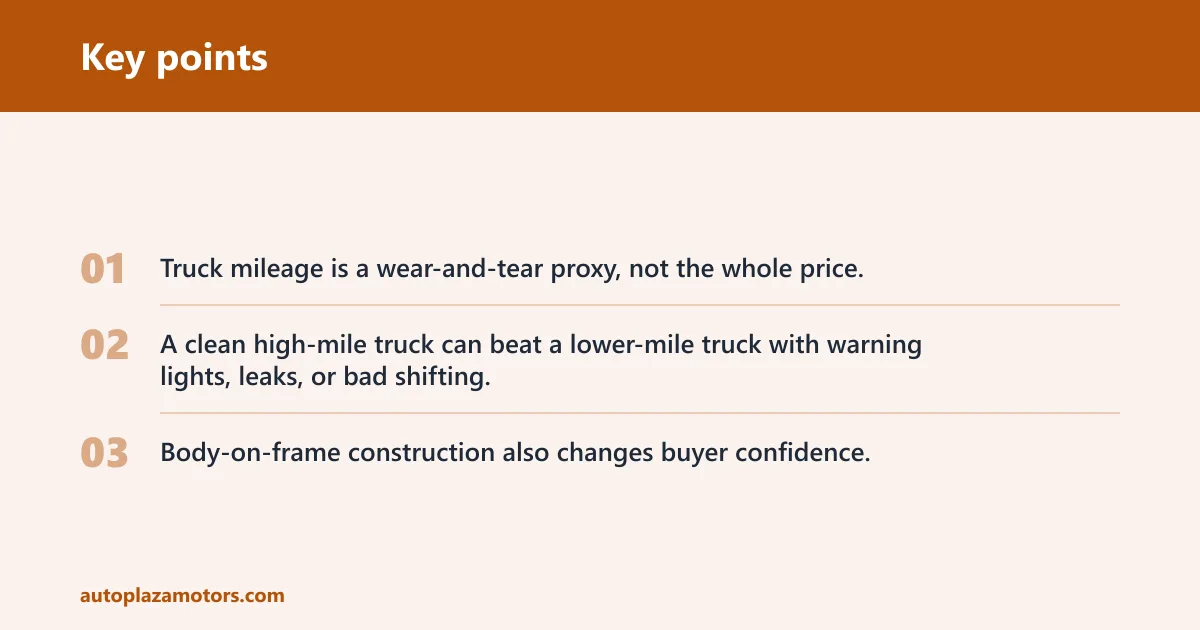
Truck mileage is a wear-and-tear proxy, not the whole price. It changes market value, but buyers also compare mechanical condition, service records, title history, corrosion, and how well the truck matches the job they need it to do. A clean high-mile truck can beat a lower-mile truck with warning lights, leaks, or bad shifting.
That is why two trucks with the same odometer reading can land in different price bands. The one with documented maintenance, no accident history, and a clean-running engine can justify a stronger asking price than a lower-mile truck with hidden repair exposure.
Why trucks hold value longer than many cars
High-mileage cars can still sell for more when buyers value the remaining mileage capacity, and the same logic applies even more strongly to pickups. Trucks are often bought for utility use, so buyers pay for payload, towing potential, and a cab or bed layout that fits the work.
Body-on-frame construction also changes buyer confidence. It does not make a truck immune to wear, but it does make many shoppers more tolerant of higher mileage when the truck still starts cleanly, shifts properly, and shows no major corrosion underneath.
What makes a high-mileage truck worth more?
A high-mileage truck is worth more when it is still useful, mechanically sound, and configured in a way the market wants. Trim, engine, drivetrain, cab configuration, and bed length can move the number as much as the odometer, especially when the truck is set up for work use.
Work-truck demand and utility use
Trucks with 4×4, crew cab, diesel power, or a long bed often draw stronger demand because those features can fit more work needs. That demand can keep prices firm even when the mileage is high, especially if the truck has already passed the first maintenance milestone and continues to perform.
Some owners trade in high-mileage vehicles after warranty and first maintenance milestones pass, then the market sorts out what remains. At that point, the truck is priced less like a nearly new vehicle and more like a tool with known wear that still earns money.
Body-on-frame durability and buyer confidence
Buyers tolerate mileage better when the truck still feels solid. They look for stable idle quality, normal shifting, no warning lights, and no fluid leaks. Those signals tell them the odometer is high, but the truck has not turned into a repair trap.
That confidence matters because too many repair entries can reduce a vehicle’s market value. A truck with repeated drivetrain work, electrical repairs, and unresolved complaints often loses the trust that supports a higher price.
Exact configuration matters
Do not compare a regular cab 2WD gas truck to a crew cab 4×4 diesel long bed and expect the same answer from a valuation guide. A truck valuation should compare exact model year, trim, engine, drivetrain, cab configuration, and bed length. Heavy-duty truck configurations can also differ by single versus dual rear wheels.
Those details change who wants the truck and what that buyer will pay. A mismatch on configuration can distort the price more than a moderate mileage gap.
When does high mileage start hurting value?
High mileage starts hurting value when the added wear begins to show up in repairs, driving feel, or likely future cost. There is no single odometer number that applies to every truck. The price hit depends on condition, service history, corrosion, and whether the truck still looks ready for work.
The price hit depends on condition, not one number
Mileage by itself is a rough proxy. Once the truck starts showing starting issues, warning lights, leaks, or rough shifting, the market stops pricing it like a clean high-mile unit and starts pricing in repair exposure. That shift can happen at very different odometer readings depending on use and maintenance.
Suppose two same-year pickups both show about 180,000 miles. One has clean service records, no title brands, and no underbody rust. The other has a transmission slip, a check engine light, and corrosion around the frame. The second truck can lose far more value than the mileage alone would suggest.
Where mileage matters most in gas and diesel trucks
Gas trucks often see a more visible mileage penalty once engine noise, transmission wear, or suspension wear starts stacking up. Diesel trucks can stay expensive longer because diesel demand remains strong and many buyers accept higher repair exposure for towing, hauling, and long-service use.
That does not mean diesel is automatically better. It means the market often prices diesel trucks differently, especially when buyers expect stronger towing ability and are willing to pay more for that use case even with a high odometer reading.
Truck value checklist
This checklist helps you separate a genuinely desirable truck from one that is simply overpriced inventory. Use it before you rely on a listing price, trade-in figure, or auction number.
| Factor | Why it raises or lowers price | What evidence to verify |
|---|---|---|
| Mileage | Higher mileage usually lowers price, but less if the truck still runs and drives cleanly. | Odometer reading, annual mileage pattern, and comparison to similar listings. |
| Service records | Regular care supports confidence and can justify a stronger asking price. | Oil changes, fluid service, brake work, and other dated receipts. |
| Accident history | Crashes reduce buyer trust and can cut resale value. | History report, repair photos, panel alignment, and paint variation. |
| Corrosion | Body and underbody corrosion can lower value sharply. | Frame rust, cab corners, rocker panels, bed supports, and suspension mounts. |
| Engine behavior | Rough running signals cost and risk. | Cold start quality, warm idle sound, cam phaser noise, and misfire codes. |
| Transmission shifting | Harsh, delayed, or slipping shifts make buyers discount the truck. | Road-test shifts, delayed engagement, flare, shudder, and fluid condition. |
| Towing use | Heavy towing can raise demand for the right buyer and raise concern for wear. | Hitch wear, brake wear, cooling system history, and trailer package evidence. |
| Trim | Desirable trims can hold value better than base models. | Exact trim badge, option list, interior equipment, and package content. |
| Drivetrain | 4×4 and dual rear wheel setups can raise value in the right market. | 2WD or 4×4 status, axle setup, and rear wheel count. |
| Cab/bed configuration | The wrong layout can weaken comparison value even if mileage is similar. | Regular, extended, or crew cab; short bed, standard bed, or long bed. |
| Title status | Title brands reduce confidence and usually lower price. | Clean title or branded title, salvage history, and lien status. |
| Repair estimates | Big repair bills can wipe out any resale gain from fixing the truck. | Written diagnosis, itemized estimate, and as-is offer versus repaired value. |
How do condition and history change the price?
Condition and history can move a truck’s value as much as mileage. Service records, previous repairs, title brands, corrosion, and drivetrain behavior tell buyers whether the truck is a solid purchase or a future repair bill with a bed on it.
Service records and repair history
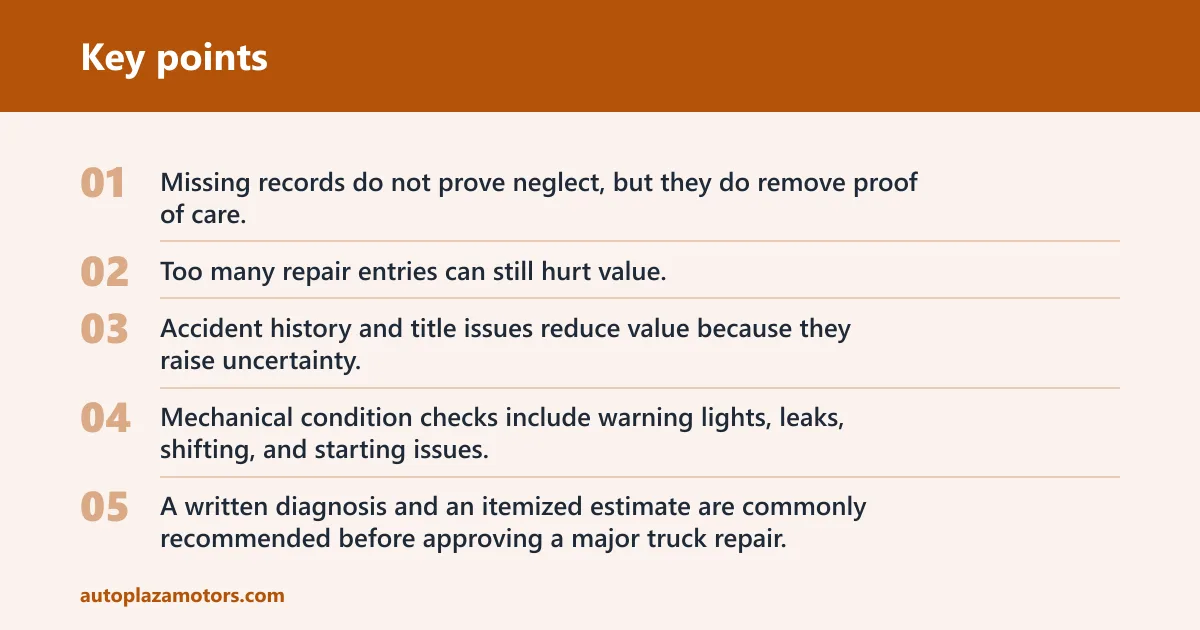
Maintenance history matters because it shows care, timing, and whether the truck followed its first maintenance schedule. It also gives a buyer a reason to trust the truck’s current condition. Missing records do not prove neglect, but they do remove proof of care.
Too many repair entries can still hurt value. A long list of repeated fixes suggests a truck may be aging into expensive ownership, even if it drives reasonably well today.
Accident history, title brands, and corrosion
Accident history and title issues reduce value because they raise uncertainty. A branded title, prior structural damage, or incomplete repair work can make the truck harder to finance, harder to resell, and harder to price with confidence.
Corrosion matters for the same reason. Body and underbody corrosion can affect a truck’s value because it points to hidden expense, especially on frame parts, brake lines, suspension mounts, and cab corners.
Engine noise, starting issues, and shifting quality
Mechanical condition checks include warning lights, leaks, shifting, and starting issues. Those signs matter because a truck that runs cleanly on a high odometer can outprice a lower-mile truck that starts hard, knocks, or slips in gear.
Engine noise deserves its own attention. Ford documented cam-phaser noise in certain 2017–2020 F-150 models with the 3.5-liter EcoBoost, and its service information describes cold-start rattling and warm-idle knocking in those trucks. A written diagnosis and an itemized estimate are commonly recommended before approving a major truck repair.
A common first-timer mistake is to hear a brief rattle and dismiss it as normal. If the noise repeats cold, carries into warm idle, or comes with a check engine light, the truck may need a documented diagnosis before the price makes sense.
Should you fix it or sell it as is?
Compare the repair bill to the resale gain before you spend money. A truck should only get major work when the fix increases the likely sale price enough to justify the bill, time, and risk. Otherwise, an as-is offer may be the better move.
Compare repair cost with resale gain
Start with a written diagnosis and itemized estimate. Then compare three numbers: the repair bill, the as-is offer, and the likely resale value after the fix. If the repair costs more than the value it adds, the math is weak.
Get a written diagnosis. Ask for a clear fault description and an itemized estimate before approving major work. This matters most for engine noise, transmission complaints, and corrosion-related repairs.
Request two price numbers. Get the as-is offer and the likely repaired value. Use the same trim, drivetrain, cab, bed, and engine when comparing both figures.
Subtract the repair bill. If a truck may sell for about $1,500 more after a fix but needs about $2,400 in work, the repair likely does not improve the sale math. The gap matters more than the asking price.
Check time and risk. Extra downtime, new hidden faults, and a failed repair can erase expected gain. That risk is higher when the truck already has a long repair history or corrosion.
When an as-is offer is the better move
Sell as-is when the truck has heavy corrosion, repeated repairs, title issues, or a major problem that does not raise resale enough to cover the fix. That approach often makes sense when the truck still has value as a work unit but no longer makes financial sense as a repair project.
Picture a diesel crew cab 4×4 with 220,000 miles, a known transmission issue, and a frame that shows surface rust in several spots. If the repair estimate is close to the value gain, selling as-is can protect you from sinking money into a truck the market already discounts.
How to compare truck values correctly
Use valuation tools as references, not final answers. Common valuation guides and market values are not interchangeable, and none of them replaces a configuration match on year, trim, engine, drivetrain, cab, and bed.
Match the same truck, not the same nameplate
A single model name can hide major price differences. A base V6 2WD regular cab should not be compared directly with a diesel 4×4 crew cab with a long bed. If the setup does not match, the value reference can mislead you.
Use the same year and the same configuration before you compare book numbers. That is the only way to see whether the asking price reflects real market demand or a listing that is padded by a generic trim description.
Use the right value type for the decision
Retail value matters if you are buying from a dealer. Trade-in value matters if you are swapping it in. Wholesale and auction value matter when you want to understand the lower end of the market and what dealers may have in the truck.
That spread is normal. A truck can look expensive at retail and still be priced fairly if the configuration is scarce, the history is clean, and the mechanical condition is strong.
Frequently asked questions
Why are high mileage diesel trucks so expensive?
Diesel trucks often hold stronger prices because buyers value towing ability, durability expectations, and diesel-specific demand. That does not erase wear or repair exposure, but it does mean a high-mile diesel can price above a comparable gas truck when the configuration and condition fit what buyers want.
What makes a high-mileage truck hold value?
A high-mileage truck holds value when it still starts well, shifts cleanly, lacks major leaks, and has proof of care. Exact configuration matters too. Year, trim, engine, drivetrain, cab, and bed length can keep a truck desirable even after the odometer climbs.
Does maintenance history matter more than mileage on a used truck?
Maintenance history can matter as much as mileage, and sometimes more. A well-documented truck gives buyers confidence that the odometer reading did not come from neglect. Missing records do not prove damage, but they do make the asking price harder to defend.
When does high mileage start hurting a truck’s value?
High mileage starts hurting value when it comes with visible wear, repair history, or weak driving behavior. There is no single number that applies to every truck. Once the market sees corrosion, warning lights, or shifting problems, the price can drop fast.
How do repair history and corrosion affect a truck’s price?
Repair history and corrosion both reduce buyer confidence. Too many repair entries can lower market value, and body or underbody corrosion can make a truck much harder to price. Buyers usually discount anything that suggests hidden cost or future downtime.
Should I fix an expensive problem before selling a high-mileage truck?
Only if the repair cost is lower than the resale gain it creates. Get a written diagnosis, compare the as-is offer with the repaired value, and include downtime risk. If the math does not clearly favor the repair, selling as-is is often the cleaner choice.