

What Determines Payload Capacity?
Payload capacity is the maximum weight a vehicle can carry. It starts with GVWR minus curb weight, then axle ratings and tire limits can lower the usable figure. Ignore it and you can overload suspension, tires, brakes, and steering, or push a truck past legal and warranty limits. This guide explains GVWR, curb weight, axle ratings, added equipment, and how real loading changes the number on the sticker.
What payload capacity means
Payload capacity is the weight left for people, cargo, and trailer tongue weight after the vehicle’s own weight is accounted for. It is not the same as towing capacity. A truck, SUV, or van can have a strong tow rating and still run out of payload once passengers, tools, or a hitch load are added.
Payload versus towing capacity
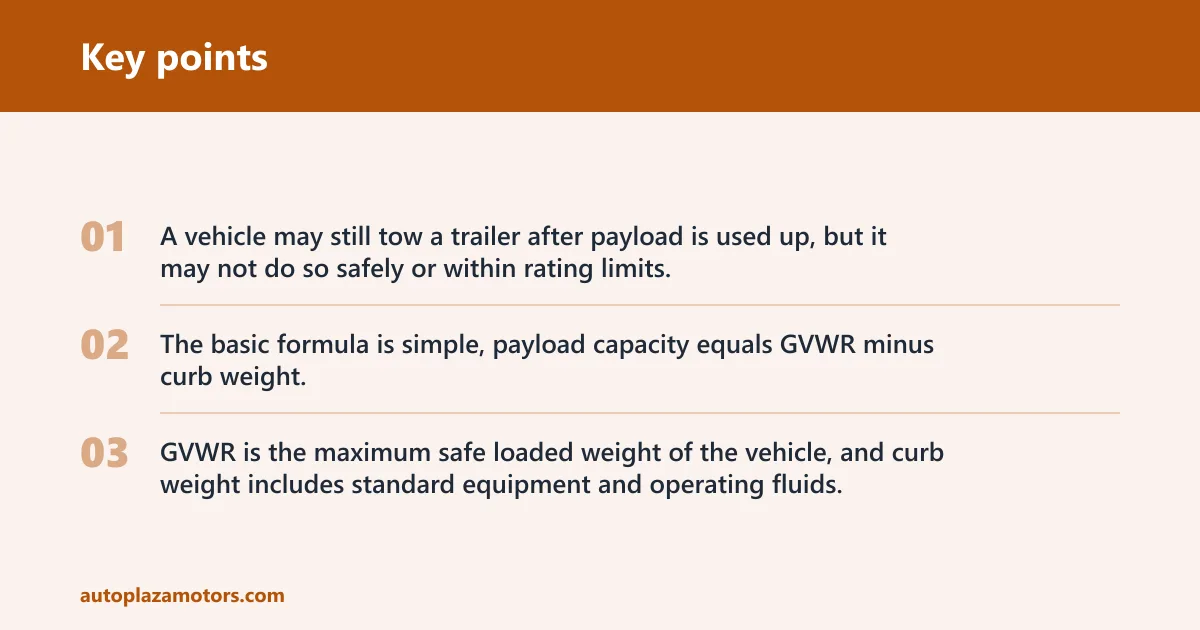
Towing capacity tells you how much trailer a vehicle can pull, while payload tells you how much total load it can carry on its own structure and axles. Those numbers move for different reasons. A vehicle may still tow a trailer after payload is used up, but it may not do so safely or within rating limits.
Where the payload number comes
The basic formula is simple, payload capacity equals GVWR minus curb weight. GVWR is the maximum safe loaded weight of the vehicle, and curb weight includes standard equipment and operating fluids. That means the sticker figure starts as a math result, then gets reduced by options, upfits, axle limits, and tire limits.
How GVWR and curb weight set the baseline
GVWR and curb weight are the starting points for every payload calculation. GVWR sets the top line for the loaded vehicle, while curb weight sets the subtraction point. If curb weight goes up, payload goes down. If GVWR stays the same, there is no extra room just because the vehicle looks empty.
Finding GVWR on the door placard
Most vehicles list GVWR on the door pillar or door-jamb placard, and it may also appear in the owner’s manual. That number is manufacturer-set. The truck class chart also places Class 2a at 6,001 to 8,500 lbs GVWR, and Class 3 at 10,001 to 14,000 lbs GVWR. Those classes do not change the math, but they help frame the size of the load system.
Using curb weight as the subtraction point
Curb weight includes standard equipment and operating fluids such as fuel, oil, coolant, and other fluids. It does not include passengers or cargo. A truck with 9,000 lbs GVWR and 6,000 lbs curb weight has 3,000 lbs payload. The same GVWR with 5,000 lbs empty weight has 4,000 lbs payload.
What else changes payload capacity
Payload is not fixed across all trims, cab styles, bed lengths, drivetrains, or factory equipment. The same nameplate can hide very different useful load numbers. A crew cab with a long list of options often carries less than a simpler regular cab, even when the badge on the fender looks identical.
Cab, bed, and drivetrain differences
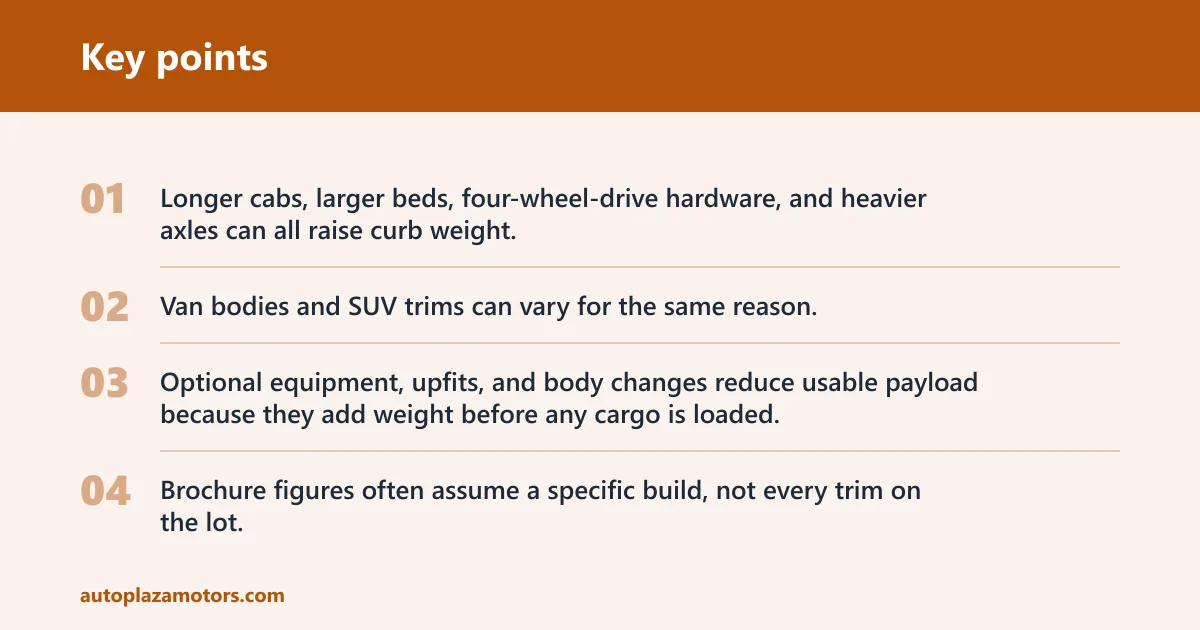
Longer cabs, larger beds, four-wheel-drive hardware, and heavier axles can all raise curb weight. That lowers available payload. Van bodies and SUV trims can vary for the same reason. A high-roof van with shelves, partitions, or rear air conditioning may have a lower usable payload than a plain cargo version built on the same platform.
Factory options and added equipment
Optional equipment, upfits, and body changes reduce usable payload because they add weight before any cargo is loaded. Steps, bed liners, winches, toppers, service bodies, liftgate hardware, and camper modules all eat into the number on the sticker. Brochure figures often assume a specific build, not every trim on the lot.
Picture a pickup that leaves the factory with a basic cab and no bed accessories, then gets a steel service body and a ladder rack. The door sticker may still show the original rating label, but the usable payload for that actual truck is lower once the added equipment is counted.
Why passengers and cargo count
Passengers count toward payload, and so does every item in the cab, bed, or cargo area. Payload is not just bed load. If two adults, two children, a cooler, and tools are on board, all of that weight comes out of the same allowance as lumber or luggage.
Cabin passengers and their gear
People take up payload first, often before cargo does. A full crew cab can use hundreds of pounds before the bed is loaded, and child seats, backpacks, and recovery gear still count. The rating does not care where the weight sits; it cares about total loaded mass.
Bed cargo, luggage, tools, and materials
Bed cargo, luggage, tools, materials, and shop supplies all count toward payload. Dense cargo reaches the limit faster than bulky light cargo because weight, not volume, is the issue. Bags of concrete, tile, batteries, and steel parts can use payload much more quickly than camping gear or foam insulation.
How tongue weight cuts into payload
When towing, tongue weight uses part of the same payload reserve that passengers and cargo use. Tongue weight is the downward force on the hitch, and a common rule of thumb is 10-15% of trailer weight. If the trailer carries load on the hitch, that load is part of the truck’s payload problem.
Why trailer weight is not free payload
A 2,000-pound trailer can reduce payload to 2,800 pounds in the example given because the hitch load still counts against the truck. That means the trailer does not sit outside the rating system. The truck must carry the hitch force, plus everyone riding inside, plus anything in the bed or cargo area.
How much tongue weight usually subtracts
At 10-15% of trailer weight, a 5,000-pound trailer can place about 500 to 750 pounds on the hitch. That is weight the vehicle must support. Once passengers are in the cab, the remaining payload can disappear quickly, even if the trailer itself seems well within tow rating.
Suppose a SUV has 1,200 pounds of payload left after passengers. Add a trailer with 600 pounds of tongue weight, and only 600 pounds remain for a cargo box or extra gear. The trailer did not just add load, it reduced the room left for everything else.
Frame, suspension, brakes, axles, and tires

The frame, suspension, brakes, axles, and tires set the real carrying limit, not just the math on the placard. GVWR is one limit. Gross axle weight rating is another. A vehicle can stay under GVWR and still overload a rear axle, a tire, or the suspension on one end.
Why axle ratings can bind before GVWR
Axles carry load distribution, so weight location matters. A heavy hitch load, rear-seat passengers, or bed cargo stacked near the tailgate can push the rear axle past its rating while the total vehicle weight still looks acceptable. That is why axle ratings matter as much as the overall number.
How tires and brakes limit safe loading
Tires are load-carrying components, and overload raises heat, wear, and failure risk. Brakes also face more strain because extra mass takes more force to slow down, which lengthens stopping distance. Suspension and frame strength shape how the load is carried and how stable the vehicle feels over bumps, turns, and braking.
-
Check the door sticker.
Read the GVWR, axle ratings, and tire information on the door-jamb placard before loading anything. Then compare those numbers with the owner’s manual if the placard is missing or unclear, because the printed ratings are the baseline for every decision that follows.
-
Weigh passengers first.
Add the weight of everyone who will ride in the vehicle, plus child seats and personal items in the cab. Those pounds come off payload before cargo or tongue weight is added.
-
Add cargo and hitch load.
Estimate bed cargo, luggage, tools, and trailer tongue weight together. Use 10-15% of trailer weight for the hitch load unless the trailer maker specifies a different target, because that force belongs inside the payload calculation.
-
Compare axle loading.
Check whether the rear axle, rear tires, or hitch area will take more weight than the sticker allows. If the rear end is the first limit hit, the vehicle is overloaded even if the total weight still sits under GVWR.
-
Trim or redistribute weight.
Move cargo forward, remove accessories, or reduce passenger and trailer load if any rating is over the line. Redistribution helps only when it brings axle loads and tire loads back into range; it does not create extra payload.
Payload decision table
Use this table as a quick screen against the door sticker and your actual load. The “remaining payload” column shows what is left after passengers, cargo, and tongue weight are counted together.
| GVWR | Curb weight | Passenger weight | Cargo weight | Tongue weight | Remaining payload | Overload risk |
|---|---|---|---|---|---|---|
| 9,000 lbs | 6,000 lbs | 400 lbs | 300 lbs | 0 lbs | 2,300 lbs | Low if axle and tire ratings also stay within limits |
| 9,000 lbs | 6,000 lbs | 600 lbs | 250 lbs | 200 lbs | 1,950 lbs | Moderate if the rear axle carries most of the hitch load |
| 9,000 lbs | 6,000 lbs | 700 lbs | 300 lbs | 600 lbs | 1,400 lbs | High if trailer gear is added or cargo shifts rearward |
| 9,000 lbs | 5,000 lbs | 500 lbs | 600 lbs | 0 lbs | 2,900 lbs | Depends on rear axle and tire capacity |
- Check whether the rear axle reaches its rating before GVWR does.
- Look for heavy accessories such as toppers, racks, winches, or service bodies.
- Watch tire sidewall load limits, not only the door placard total.
- Recheck tongue weight after cargo shifts in the trailer or truck bed.
- Assume every passenger and every tool box uses the same payload pool.
Frequently asked questions
What determines the payload capacity of a truck
Truck payload capacity starts with GVWR and curb weight, then gets limited by axle ratings, tire load capacity, suspension, brakes, frame strength, and added equipment. Cab size, drivetrain, bed style, and options change the curb weight, so the payload number can differ sharply between two trucks with the same badge.
What factors determine payload capacity
The main factors are GVWR, curb weight, axle ratings, tires, suspension, brakes, frame strength, and any added equipment. Passenger weight, cargo, and tongue weight all reduce the usable figure in real use. Optional body changes can lower payload further, even if the brochure number looks generous.
How does curb weight affect payload capacity?
Curb weight is the subtraction point in the payload formula, so a heavier vehicle leaves less room for people and cargo. Because curb weight includes standard equipment and operating fluids, extra factory gear or upfits reduce payload before loading starts. A lighter build usually leaves more carrying room.
Does payload capacity include passengers?
Yes. Payload includes people and cargo, not just bed load. Every passenger, child seat, cooler, and tool bag counts toward the same limit. If the cab is full, the truck can run out of payload before the bed is even packed. (Firestonecompleteautocare)
How do GVWR and curb weight determine payload capacity?
Payload capacity equals GVWR minus curb weight. GVWR is the maximum safe loaded weight of the vehicle, and curb weight is the vehicle with standard equipment and operating fluids but no passengers or cargo. That formula gives the starting payload figure before axle, tire, and hitch limits are checked.
Why is my payload capacity lower when towing?
Because tongue weight comes out of payload. A trailer may have a 10-15% tongue load, and that downward force sits on the hitch and rear axle. Once passengers and cargo are added, the remaining payload can shrink quickly, even if the trailer weight itself seems manageable.
