
What Does a Worn Suspension Feel Like in a High Mileage SUV?
A worn suspension in a high-mileage SUV often feels like extra bounce, wandering steering, nose dive, clunks, or uneven tire wear; if it rebounds more than once after a bump, inspect it. Left alone, it can stretch stopping distances and turn low-cost wear parts into tire, brake, and alignment bills. This guide explains the feel, what it points to, and which symptoms are normal aging versus red flags.
Common suspension symptoms in a high-mileage SUV
A tired SUV suspension usually shows up as float after bumps, more nose dive under braking, heavier body roll in turns, and small knocks over rough pavement. In a high-mileage SUV, those signs often get worse when the vehicle is loaded with passengers, cargo, a roof rack, or towing weight.
Bounce and float
Shocks control damping and rebound, so the driver should feel one controlled rebound after a bump, not a repeated bobbing motion. Worn shock absorbers may let the vehicle bounce repeatedly after bumps, and excessive tire bouncing is a sign of worn shocks or struts. That extra motion can feel like the SUV is still settling long after the road input is gone.
Nose dive and squat
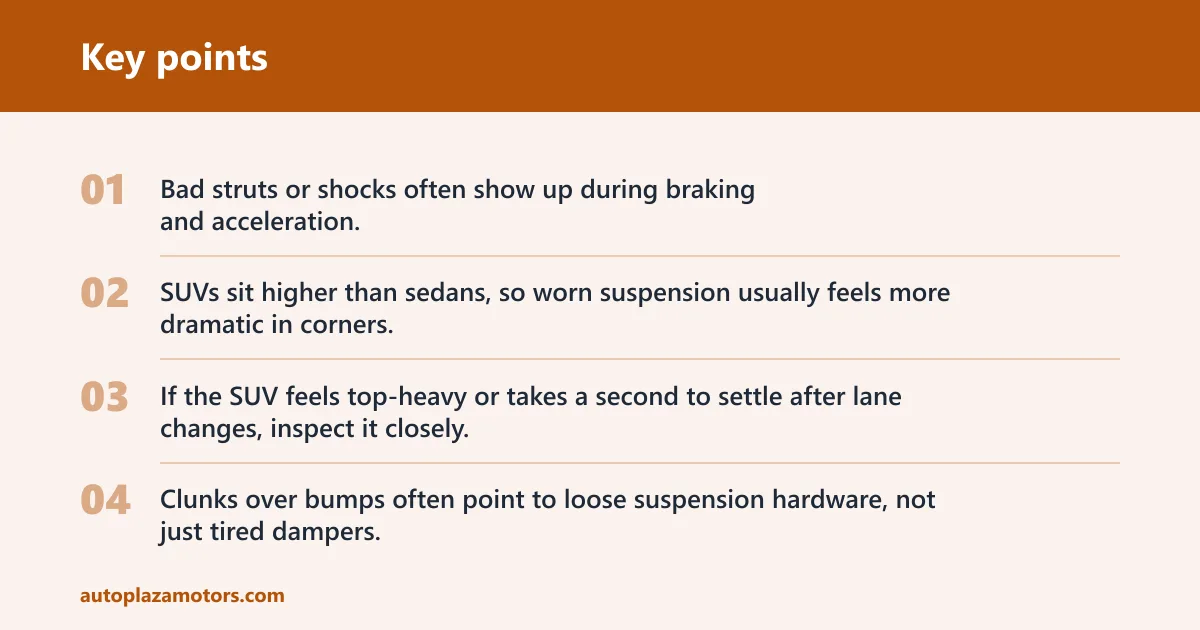
Bad struts or shocks often show up during braking and acceleration. Hard braking may produce more front-end dive than expected, while a soft rear end can squat more than it should with passengers or cargo in the back. Struts are structural suspension components, and when seals fail they can leak fluid and lose control of the spring’s motion.
Body roll and sway
SUVs sit higher than sedans, so worn suspension usually feels more dramatic in corners. A vehicle can tip to one side in turns when shocks or struts wear out, and worn sway bar links or sway bar bushings can make that body roll feel sloppy or delayed. If the SUV feels top-heavy or takes a second to settle after lane changes, inspect it closely.
Clunks, rattles, and vague steering
Clunks over bumps often point to loose suspension hardware, not just tired dampers. Bushings can crack, soften, or separate with age and create clunks and vague steering, while worn control arm bushings can cause looseness and uneven tire wear. A spongy steering feel can point to worn bushings in steering or control arms, and ball joints should be checked for wheel play because excessive looseness can be dangerous.
| Sensation the driver notices | Most likely worn component(s) | How urgent it is before buying | Test-drive decision |
|---|---|---|---|
| Bounce or float after a bump | Shocks, struts, tired springs | Inspect soon if it is mild; walk away if it keeps bouncing more than two times | Inspect |
| Nose dive under braking | Front shocks, front struts, worn bushings | Inspect; stronger dive suggests confirmed wear | Inspect |
| Side-to-side sway in curves | Shocks, struts, sway bar links, sway bar bushings | Inspect quickly; severe sway is a control concern | Inspect |
| Clunk over bumps | Control arm bushings, ball joints, sway bar links, sway bar bushings | Urgent if the clunk is sharp, repeated, or paired with looseness | Inspect |
| Steering vagueness | Control arm bushings, ball joints, worn geometry, alignment knock-on effects | Urgent if the SUV wanders or needs constant correction | Walk away |
| Tire cupping | Worn shocks or struts, sometimes linked to loose suspension parts | Inspect; it often means wear has been present for a while | Inspect |
| One-corner sag | Spring, strut, or related mounting hardware | High urgency because ride height differences are a warning sign | Walk away |
What parts usually fail first?
On a high-mileage SUV, shocks and struts are often the first parts to fade, but they are not the only suspects. Control arms, bushings, ball joints, sway bar links, sway bar bushings, and springs can all wear enough to change how the vehicle feels from the driver seat. Some of those issues are a comfort problem; others are a safety problem.
Shocks and struts
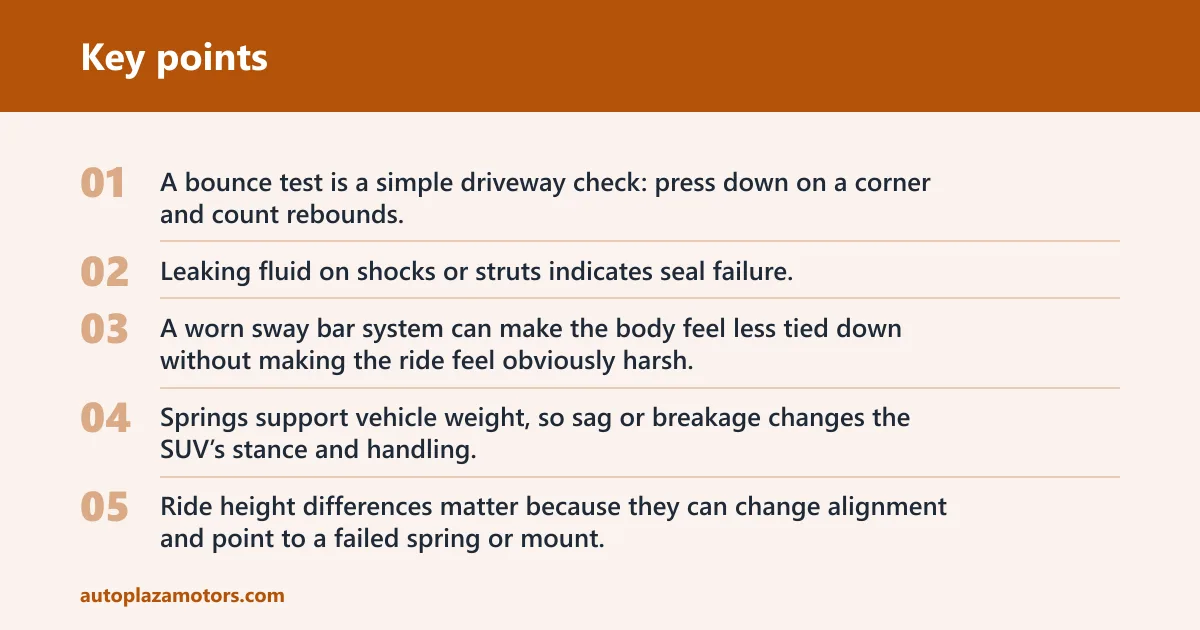
Shocks and struts control motion. They often fail before major hard parts on high-mileage vehicles, and most shocks and struts may last 75,000 to 90,000 miles under normal conditions. A bounce test is a simple driveway check: press down on a corner and count rebounds. One bounce is described as normal in the inspection process, while more than two bounces suggests the shock or strut is worn.
Leaks matter too. Leaking fluid on shocks or struts indicates seal failure. That does not prove every squeak comes from the damper, but it is strong evidence that the unit has lost damping control.
Control arms, bushings, and ball joints
Control arms link the wheels to the chassis, so worn bushings can let the wheel move too much and make the SUV feel loose. That looseness can show up as vague steering, clunks, or uneven tire wear. Ball joints are safety-critical pivot points, so they should be checked for play if the front end feels sloppy or the steering wheel does not settle cleanly.
Sway bar links and sway bar bushings
Sway bar parts control body roll, so they often announce themselves with rattles or clunks over small bumps and in corners. If the SUV feels okay in a straight line but chatters over driveway edges, speed humps, or potholes, these parts move higher on the suspect list. A worn sway bar system can make the body feel less tied down without making the ride feel obviously harsh.
Say your 3-row SUV feels fine on smooth highway pavement but clunks twice when crossing a parking-lot speed bump with three passengers on board. That pattern points more toward sway bar links, bushings, or a loose mount than a simple tire issue.
Springs and ride-height sag
Springs support vehicle weight, so sag or breakage changes the SUV’s stance and handling. A one-corner sag is often treated as a warning sign, especially if the wheel arch sits lower on one side or the SUV leans when parked on level ground. Ride height differences matter because they can change alignment and point to a failed spring or mount.
How do you check suspension wear before buying?
Before buying a high-mileage SUV, you want a quick screen that catches obvious wear and separates normal softness from unsafe looseness. Start with a bounce test, then look for leaks, damaged bushings, ride-height differences, and abnormal tire wear. Finish with a short road test that includes braking, cornering, and a rough surface.
Press each corner. Push down and release one corner at a time. More than one or two rebounds is a warning sign, and more than two bounces suggests the shock or strut is worn.
Look underneath. Check shocks and struts for wet fluid, torn boots, cracked bushings, and obvious damage. Leaks on shocks or struts point to seal failure, while split rubber around control arms or sway bar parts can explain clunks and loose steering.
Inspect tire wear. Look for cupping, feathering, and inner or outer edge wear. Those patterns are clues about suspension geometry and damping, not only tire age.
Drive over mixed surfaces. Include a braking stop, a few curves, and a rough patch or expansion joint. Note whether the SUV dives hard, sways late, wanders, or taps repeatedly after a bump.
Suppose a used SUV tracks straight on a test drive but the front tires show cupping and the nose dips hard when braking from 35 mph. That combination points toward worn shocks or struts, and it deserves a closer inspection before you sign anything.
Wheel alignment matters, but it is not the same as fixing worn suspension. An alignment can help a vehicle that is simply out of spec, yet it may not hold if bushings, ball joints, or springs are worn and letting the geometry shift under load.
What tire wear patterns reveal suspension wear?
Tire wear often tells the story before the SUV feels obviously unsafe. Cupping, feathering, and edge wear all point to how the wheel is moving as it rolls down the road. That makes tires a diagnostic clue, not just a maintenance item.
Cupping
Cupping looks like alternating high and low spots around the tread. It is often caused by worn shocks that let the tire bounce repeatedly, especially on rough roads. If the tire noise rises and falls in a rhythmic pattern, the suspension should be inspected even if the vehicle still feels acceptable on smooth pavement.
Feathering
Feathering usually means the wheel is toeing in or out because of worn suspension parts. You can often feel it by running a hand lightly across the tread blocks in both directions, where one direction feels sharper than the other. If feathering appears on both front tires, suspect worn bushings, ball joints, or alignment that will not stay set.
Inner-edge and outer-edge wear
Inner or outer tire-edge wear can indicate camber-related suspension wear. That pattern often shows up when the suspension no longer holds the wheel upright as designed. If one side of the tread is visibly thinner while the other side still looks normal, do not dismiss it as a simple tire rotation issue.
When is it unsafe enough to walk away?
Walk away when the SUV shows signs that go beyond age-related softness and into control or safety concerns. One-corner sag, excessive wheel play, repeated clunking with looseness, or steering that feels vague at highway speed are major warning signs. If the SUV cannot brake, turn, or track straight with confidence, it is not a bargain.
One-corner sag
A vehicle that sits low on one corner may have a broken spring, failed strut, or damaged mount. That can change handling, tire wear, and alignment all at once. If the ride height difference is obvious from a few feet away, the suspension needs professional attention before purchase.
Excessive play or clunking
Ball joints and control arm bushings deserve special attention here. Excessive looseness can be dangerous, and a repeated metallic clunk over bumps often means the suspension is moving more than it should. If the sound is paired with steering wander or a loose front end, walk away unless the vehicle has already been repaired and documented.
Stopping distance and control
Worn shocks and struts can contribute to instability at highway speeds and hard braking may produce more front-end dive than expected. That extra motion can increase stopping distance and reduce control during lane changes or emergency maneuvers. A soft ride alone is not proof of danger, but a soft ride plus brake dive, sway, or wheel play is a problem.
Can worn suspension cause longer stopping distances? Yes, because the tires may not stay planted as well during braking. The effect can be subtle at first, then more obvious when the SUV is loaded or the road is uneven.
Frequently asked questions
What does a worn suspension feel like while driving?
It usually feels like extra bounce, float after bumps, more body roll in turns, and loose or vague steering. In an SUV, those symptoms are often easier to notice because the vehicle sits higher and reacts more to weight transfer, passengers, cargo, and rough pavement.
How do I know if my SUV shocks or struts are bad?
Watch for repeated bouncing after a bump, nose dive under braking, and fluid leaking from the unit. A bounce test helps: one bounce is normal, while more than two suggests a worn shock or strut. If both front tires show cupping, the front dampers deserve close inspection.
Can worn suspension make an SUV bounce or sway at highway speed?
Yes. Worn shocks and struts can let the body keep moving after a lane change, dip, or road seam, which feels like highway float or sway. That effect is often stronger in tall SUVs, especially when they are carrying people, cargo, or roof weight.
Is clunking over bumps a suspension problem or something else?
It is often suspension-related, but the source may be sway bar links, sway bar bushings, control arm bushings, ball joints, or a worn strut mount. A sharp clunk over small bumps usually points to looseness, while a dull thud can come from a tired damper or spring issue.
What tire wear patterns point to worn suspension on an SUV?
Cupping often points to worn shocks or struts, feathering often points to toe change from worn suspension parts, and inner or outer edge wear can point to camber-related wear. Those patterns matter because they can show up before the SUV feels obviously loose or unsafe.
Should I replace shocks and struts in pairs?
Replacing them in pairs is often the better choice because side-to-side damping should match. If one unit is worn enough to fail the bounce test or leak fluid, the opposite side is often not far behind, and uneven damping can make the SUV feel unbalanced in braking and cornering.
