What Noises Should You Never Ignore on a High-Mileage SUV?
Do not ignore the most serious noises: metal-on-metal grinding, loud knocking, and a serpentine-belt squeal that comes with overheating, warning lights, or loss of power. Those usually mean park the SUV and stop driving. Waiting can turn a brake, bearing, or engine problem into a tow bill and a much larger repair. This guide sorts common high-mileage SUV noises into normal wear, repair-soon, and stop-now categories.
Which noises mean stop driving now?
Stop driving immediately if the noise comes with braking failure, overheating, severe vibration, or a deep engine knock that rises with engine speed. Those are the sounds most likely to signal a brake-system problem, an overheating event, or internal engine damage, and continued driving can raise both safety risk and repair cost fast.
Grinding during braking
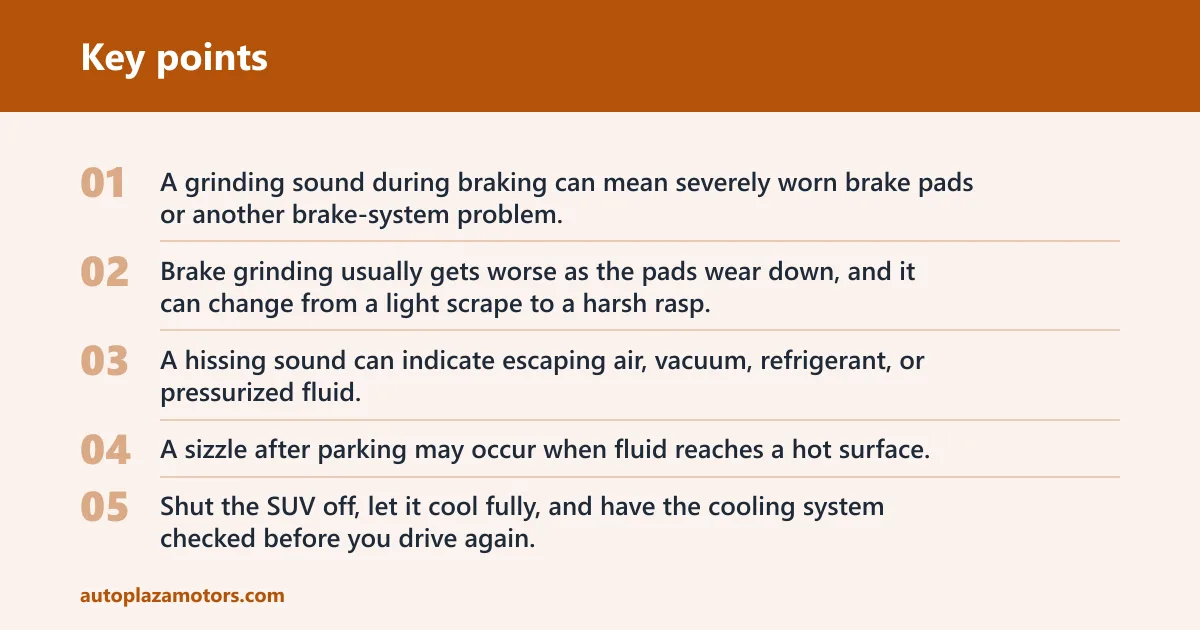
A grinding sound during braking can mean severely worn brake pads or another brake-system problem. Metal-on-metal contact can damage rotors and may reduce braking performance, so this is an inspection-urgent symptom rather than a “watch it for a week” noise.
Brake grinding usually gets worse as the pads wear down, and it can change from a light scrape to a harsh rasp. If pedal feel changes, stopping distance grows, or the SUV pulls to one side under braking, park it and schedule a brake inspection right away.
Hissing, sizzling, or steam after driving
A hissing sound can indicate escaping air, vacuum, refrigerant, or pressurized fluid. If it is paired with steam, a hot smell, or a temperature warning, treat it as an overheating risk and do not open the cooling system when hot. A sizzle after parking may occur when fluid reaches a hot surface.
That combination can mean coolant or another fluid is escaping onto a hot part. Shut the SUV off, let it cool fully, and have the cooling system checked before you drive again.
Deep engine knocking with vibration
Deep knocking that rises with engine speed is especially concerning. On a high-mileage SUV, that pattern can point to low oil level or internal engine problems, and severe vibration makes it less safe to continue. If the oil warning light is on, stop the engine as soon as it is safe to do so.
Engine knock is different from a light tick. A knock usually sounds heavier, lower, and more forceful. If it follows throttle input or gets louder as rpm climbs, the engine needs prompt diagnosis rather than a wait-and-see approach.
SUV noise triage table
Use this table as a first-pass filter before you decide whether to drive, park, or book an inspection. The same sound can mean different things depending on whether it follows engine speed, road speed, turning, or idling in gear.
| Noise | Most likely system | Engine-speed or road-speed related? | Immediate risk level | Next best check to request |
|---|---|---|---|---|
| Grinding when braking | Brake system | Road-speed related while slowing | High | Brake pad thickness, rotor condition, caliper function |
| High-pitched squeal under the hood | Accessory belt, tensioner, pulley | Often engine-speed related | Moderate to high | Belt wear, belt tension, pulley alignment, tensioner condition |
| Deep knock that rises with rpm | Engine internals, oiling system | Engine-speed related | Very high | Oil level check, oil pressure check, engine noise diagnosis |
| Clicking or popping while turning | CV joint | Most noticeable during turning, often low-speed maneuvering | Moderate to high | CV axle boots, joint play, front-axle inspection |
| Humming or growling that rises with speed | Wheel bearing, tire wear | Road-speed related | High | Wheel bearing play, tire wear pattern, road test with turns |
| Whining or buzzing | Transmission fluid, transmission, differential, transfer case | Can be engine-speed or road-speed related | Moderate to high | Fluid level and condition, leak check, scan for transmission codes |
| Whirring in gear or at a stop | Torque converter | In gear or idling at a stop | Moderate | Transmission fluid condition, torque converter noise check |
| Rapid vibration with shifting issues | Shift solenoid or hydraulic control | Related to shifting events | Moderate to high | Transmission scan, solenoid operation, fluid condition |
| Clunk from Park to Drive or Reverse | Driveline or axle components | Load change, not pure rpm or road speed | Moderate | Universal joints, differential gears, undercarriage mounts |
| Hissing or sizzling after parking | Cooling system or escaping pressurized fluid | Often after shutdown | High | Cooling system pressure check, hose and leak inspection |
How do you tell engine-speed noise from road-speed noise?
Engine-speed noise rises and falls with rpm, even if the SUV is sitting still. Road-speed noise follows vehicle speed, so it stays tied to how fast the wheels turn. That difference helps separate engine, belt, and transmission clues from wheel bearing, tire, and driveline clues.
Hold the SUV still. In Park, lightly raise engine speed and listen. If the noise changes with rpm while the vehicle is stationary, focus on the engine, accessory belt, tensioner, pulley, or transmission.
Repeat at a steady roll. Drive at a constant speed on a quiet road. If the noise grows with speed instead of rpm, move wheel bearing, tire, differential, transfer case, and axle components higher on the list.
Turn and brake separately. A noise that changes when you steer often points to a CV joint or wheel bearing. A noise that changes during braking belongs in the brake system first, even if it seems louder at the front of the SUV.
Noise that rises and falls with engine rpm
That pattern often points to the accessory belt system, engine internals, or transmission-related components. A high-pitched squeal can come from a slipping or worn accessory belt, and the squeal may also involve a tensioner or a pulley. Deep knocking that rises with engine speed is the more serious version of this pattern.
Say your SUV squeals only at cold start for 5 to 10 seconds, then quiets down. That leans toward a belt, tensioner, or pulley issue rather than a wheel bearing, because the symptom tracks engine operation, not road speed.
Noise that tracks vehicle speed at steady rpm
Humming or growling that rises with road speed can come from tire wear or a wheel bearing. It may change when turning, which is why a straight-road drone is not the whole story. A wheel bearing is safety-related, so do not wait long on this one.
Noise that changes while turning, braking, or shifting load
Clicking or popping while turning can be associated with a worn CV joint, especially on tight turns in front-wheel-drive and all-wheel-drive vehicles. A clunk from Park to Drive or Reverse points more toward driveline and axle components such as universal joints or differential gears.
A common first-timer mistake is calling every front-end click a wheel bearing. A worn CV joint usually shows itself most clearly on tight turns, while a wheel bearing is more likely to hum or growl and change with road speed.
What does each common SUV noise usually point to?
Each noise category has a short list of likely systems. That list is narrower on a high-mileage SUV because wear tends to cluster in parts that handle heat, load, and constant motion: brakes, belts, bearings, joints, fluid, and drivetrain components.
Brake grinding and pad wear
Grinding under braking belongs to the brake system first. The key concern is metal-on-metal contact, which can damage rotors and may reduce braking performance. Inspection urgency is high because the stopping system is already telling you it is near or past its limit.
Belt squeal, tensioners, and pulleys
A high-pitched squeal from the engine bay often points to a slipping or worn accessory belt. The tensioner and a pulley are common parts of that complaint, especially on older SUVs where rubber hardens and bearings age out. If the squeal is accompanied by charging or cooling issues, the case for immediate inspection gets stronger.
CV joints, wheel bearings, and driveline clunks
Clicking or popping while turning is classic CV-joint territory. Humming or growling that rises with road speed is more in wheel-bearing or tire-wear territory. A clunk under the vehicle when shifting from Park to Drive or Reverse is more consistent with driveline and axle components.
Transmission, torque converter, shift solenoid, and cooling clues
Whining or buzzing does not automatically mean the transmission is failing, but low fluid level or fluid breakdown can create those sounds. A torque converter with bearing wear can sound like a whirring noise in gear or while idling at a stop. A malfunctioning shift solenoid may show up as vibration or shifting trouble tied to hydraulic pressure regulation.
Is a whining noise from a high mileage SUV always a transmission problem?
No. A whining noise can come from transmission fluid problems, but it can also come from the differential, transfer case, wheel bearing, or even an accessory-related issue depending on when the sound appears. The key is whether the whine follows engine speed, road speed, or gear selection.
Low fluid level or fluid breakdown can create whining or buzzing in the transmission. That is why a fluid inspection matters before anyone assumes the whole unit needs replacement. If the noise changes in gear at a stop, a torque converter should stay on the list.
If the whine grows with speed and gets louder on one side of the SUV, a wheel bearing becomes more likely. If it changes under acceleration or deceleration, the differential or transfer case deserves a look. The sound alone is not a diagnosis.
What to check first on a whining SUV
Check fluid condition. Look for low level, dark fluid, or burnt smell where the transmission service procedure allows a safe check. Fluid breakdown can change how the unit sounds and shifts.
Note the operating state. Listen in Park, Reverse, Drive, and at steady road speed. A whine only in gear or at a stop points in a different direction than one that grows with speed.
Ask for undercarriage inspection. On AWD SUVs, request a look at the differential, transfer case, axle shafts, and wheel bearings if the whine is not clearly tied to the transmission.
What should you tell a mechanic first?
Tell the mechanic when the noise happens, where it seems to come from, and what changes it. Those three details cut diagnosis time more than a vague “it makes a noise” complaint. The best descriptions separate cold start from warm operation, braking from cruising, and turning from straight driving.
State the trigger. Say whether the sound appears at cold start, warm idle, braking, turning, accelerating, or parking. A noise that only appears after a 20-minute drive points to a different system than one that starts instantly.
Give the location. Front, rear, underhood, or undercarriage are useful clues. A front-corner click on tight turns is different from a center-underbody clunk when shifting into gear.
Describe the pattern. Say whether it rises with engine rpm, road speed, steering angle, or gear selection. If the noise changes only on left turns, or only in Drive at a stop, mention that clearly.
Report safety symptoms. Mention braking changes, steering pull, vibration, overheating warning lights, or loss of power. Those details raise the priority because they can turn a noise complaint into an immediate stop-driving issue.
What noises on a high mileage SUV mean I should stop driving immediately?
Stop driving for grinding during braking, a deep knocking engine sound that rises with rpm, or hissing and sizzling with steam or an overheating warning. Add any sudden brake fade, major vibration, or loss of power to that list. Those are the noises most likely to turn into unsafe driving fast.
What does grinding when braking mean on an older SUV?
It usually means severely worn brake pads or another brake-system problem. Metal-on-metal contact can damage rotors and may reduce braking performance, so this is not a noise to monitor casually. Have the brakes inspected as soon as possible, and park the SUV if stopping performance feels reduced.
What does clicking when turning mean on an AWD SUV?
Clicking or popping while turning often points to a worn CV joint, especially on tight turns. AWD and front-wheel-drive SUVs are common places for this symptom because the front axles work hard during steering and acceleration. The next check should focus on CV boots, axle play, and road-test confirmation.
Is a humming or growling noise more likely tires or wheel bearings?
Either is possible, but a hum or growl that rises with road speed and may change when turning leans toward a wheel bearing. Tire wear can sound similar, especially with cupping or uneven tread. A mechanic should compare both sides and check for bearing play before assuming it is only tire noise.
When is a knocking engine noise in a high mileage SUV serious?
It is serious when the knock is deep, rises with engine speed, or comes with low oil warning, vibration, or power loss. That pattern can point to low oil level or internal engine problems. Shut the engine off and have the oil level and pressure checked before driving again.
Can a hissing or sizzling noise after driving mean an overheating problem?
Yes. Hissing can indicate escaping air, vacuum, refrigerant, or pressurized fluid, and a sizzle after parking may happen when fluid reaches a hot surface. If the temperature gauge is high or steam appears, do not open the system when hot. Let it cool and inspect for leaks first.
How should I describe a noise to a mechanic so they can diagnose it faster?
Describe the sound, the exact moment it happens, and what changes it. Say whether it is grinding, squealing, knocking, clicking, humming, hissing, or rattling, then note cold or warm, braking or cruising, turning or straight, and whether it follows rpm or road speed. That gives the fastest path to the right system.