
Most Common Pickup Truck Tire Sizes by Wheel Diameter

Pickup tire sizes commonly cluster around 15-, 16-, 17-, 18-, 20-, and 22-inch wheels, and 17s and 18s are often reported as having broad OEM fitment coverage. Pick the wrong diameter and you can lose brake clearance, change ride height, and throw off speedometer readings. This guide maps the common truck tire sizes by wheel diameter and explains which pickup segments use each one.
Factory pickup tire sizes and fitment notes
Pickup tire fitment clusters by rim size because the factory wheel diameter sets the tire families that can clear brakes, suspension, and bodywork. For many modern trucks, 16-, 17-, 18-, and 20-inch wheels cover much of the stock and upgrade fitment range, while 17s and 18s are often used across a wide mix of half-ton and heavy-duty models.
“Common” here means the sizes most often seen on stock trucks, tow-oriented trims, and mild lift setups. It does not mean every truck can run every size in the same wheel diameter. A wheel-size match alone does not guarantee fitment, and you still need to check load capacity, speed rating, inflation requirements, and clearance.
| Wheel diameter | Common pickup tire sizes | Typical pickup segments | Likely use case | Approx. overall diameter | Common status | Fitment risk and speedometer note |
|---|---|---|---|---|---|---|
| 16-inch | 245/75R16, 265/75R16, LT265/75R16 | Older half-tons, work trims, some heavy-duty trucks | Tow-focused, jobsite, winter, spare-wheel friendly | Roughly 31 to 32 inches | Stock-common, tow-oriented | Lower rubbing risk at stock height; small upsizes can still affect clearance near the upper control arm and crash bar. |
| 17-inch | 265/70R17, LT265/70R17, 285/70R17 | Half-ton trucks, many heavy-duty trims | Daily driving, towing, broad OEM coverage | About 31.6 to 32.8 inches | Stock-common, tow-oriented | One of the widest OEM fitment bands; revs per mile vary enough to matter when you move from 265/70R17 to larger 33-inch class sizes. |
| 18-inch | 275/65R18, 275/70R18, LT275/70R18 | Half-tons, off-road trims, some heavy-duty trucks | Daily driving, appearance, mild off-road use | About 32.1 to 33.2 inches | Stock-common, lifted-common | Clearance can tighten faster with wider sections; check bumper valance and crash bar contact before assuming an upsized 33 fits. |
| 20-inch | 275/60R20, 275/55R20, 285/50R20 | Higher-trim half-tons, some heavy-duty trucks | Appearance, road driving, big-brake packages on some trims | About 32.7 to 33.0 inches | Stock-common, lifted-common | Sidewall is shorter, so wheel damage and load tuning matter more. Speedometer error can grow if the replacement diameter differs from the factory size. |
The table follows the way size charts are organized: wheel-size charts group metric and flotation tire sizes by compatible wheel diameter, then compare width, sidewall height, overall diameter, circumference, and revolutions per mile. That makes it easier to compare a stock 265/70R17 against a near-match such as 275/65R18 without guessing.
What do metric and LT tire sizes tell you?
Metric tire sizing gives you three key numbers: section width in millimeters, aspect ratio, and rim diameter in inches. In 265/70R17, the tire is 265 mm wide, the sidewall is 70% of that width, and it fits a 17-inch wheel. That format helps you compare overall diameter and sidewall height before you buy.
LT tires add the Light Truck designation. They are built for truck duty and are usually paired with load range labels such as C, D, and E. Those load ranges matter because they describe how the tire is built to carry load and how much inflation pressure it is designed to use, which is why LT tires are often chosen for towing and hauling.
P-metric truck tires use passenger-car-derived sizing. They usually ride a bit softer, but when they are used on trucks, their rated load must be checked in truck use and can be derated depending on the application and wheel setup. That is why a P-metric tire and an LT tire with the same size code are not the same choice for every pickup.
How to read the size code
-
Find the width first.
Read the first number in the size, such as 265 or 275. That is the section width in millimeters and it affects both stance and the amount of space the tire needs near the upper control arm, bumper valance, and crash bar. -
Check the sidewall ratio.
The second number, such as 70 or 65, is the aspect ratio. A larger ratio usually means more sidewall, which can help ride comfort and load cushioning but can also change the overall diameter enough to affect speedometer readings. -
Confirm the rim diameter.
The last number, such as 17 or 18, must match the wheel diameter. This is the filter that sorts 16-, 17-, 18-, and 20-inch pickup tire families into the right bucket.
How wheel diameter changes the common size families
Wheel diameter shapes the common truck size families because OEMs use different rim diameters for different trims and payload targets. Heavy-duty pickups often stay in LT sizes, while half-tons split between P-metric and LT depending on trim, package, and intended use. That is why a 17-inch truck tire often looks “common” across more models than a 20-inch tire.
Common 16-inch pickup sizes and where they usually appear
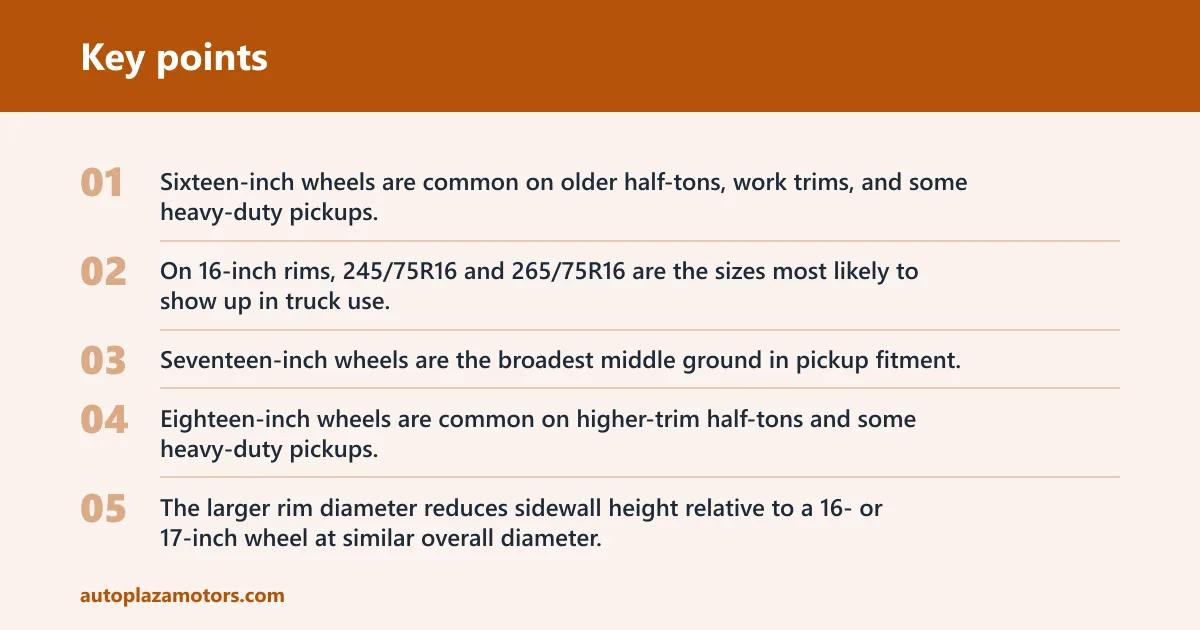
Sixteen-inch wheels are common on older half-tons, work trims, and some heavy-duty pickups. They also appear on trucks aimed at towing or fleet duty because the shorter wheel diameter leaves more sidewall. That extra sidewall can help with ride compliance and curb protection, but the tire still has to match the truck’s load needs.
On 16-inch rims, 245/75R16 and 265/75R16 are the sizes most likely to show up in truck use. They are close to the 31-inch to 32-inch OEM band, which is why they often fit stock suspension with minimal drama when the truck was built around that diameter.
Common 17-inch pickup sizes and why they are widespread
Seventeen-inch wheels are the broadest middle ground in pickup fitment. The factory mix is wide because many half-tons and many heavy-duty trucks use them, and the size family stretches from stock-common options to 33-inch class upgrades. LT265/70R17 is the most popular truck tire size in America, and the source page gives it 84% market share for light trucks.
That popularity is tied to balance. A 17-inch wheel can support daily driving, towing-focused setups, and mild off-road use without forcing a very short sidewall. For many trucks, 265/70R17 is the baseline, while 285/70R17 shows up as a common step-up size on trucks with enough clearance.
Common 18-inch pickup sizes and their typical truck use
Eighteen-inch wheels are common on higher-trim half-tons and some heavy-duty pickups. They often carry 275/65R18 or 275/70R18, and they are also a familiar base for 33-inch class fitments. The larger rim diameter reduces sidewall height relative to a 16- or 17-inch wheel at similar overall diameter.
That makes 18s common where appearance and road manners matter, but you still need to check fitment. A tire that is only slightly taller can still rub at the crash bar or bumper valance if it is also wider or if the wheel offset pushes it outward.
Common 20-inch pickup sizes and the trucks that often run them
Twenty-inch wheels are common on higher-trim half-tons and some heavy-duty trucks. They often pair with 275/60R20, 275/55R20, or similar sizes that keep overall diameter in a familiar range while giving the truck a larger-wheel look. Some trucks with larger brake packages also need a 20-inch wheel, but that is model-specific.
The tradeoff is shorter sidewall. That can change ride feel and make wheel protection and load selection more important. If the overall diameter changes from the factory size, revolutions per mile change too, so the speedometer may need calibration.
Which sizes fit towing, daily driving, or lifted trucks?
For towing and hauling, load rating and construction matter more than wheel diameter alone. LT tires with the right load range are usually the better starting point because they are built for truck duty, but they do not change the vehicle’s factory towing rating. The truck maker sets that rating.
For daily driving, P-metric truck tires can be a good fit when ride quality matters and the truck is not regularly carrying heavy payloads. For lifted trucks, the most common sizes move upward in overall diameter, but fitment risk rises because the tire gets closer to the crash bar, upper control arm, and bumper valance.
Say your half-ton came with 275/60R20 tires and you want a slightly taller look. A move to a 33-inch class tire can be fine on some trucks, but if the wheel offset is aggressive or the width increases, rubbing can show up at full lock even when the diameter seems reasonable on paper.
Suppose a work truck on 16-inch wheels needs better trailer stability. Staying in an LT size with an appropriate load range keeps the setup aligned with truck duty. Switching to a P-metric tire of the same nominal size may soften the ride, but it is not the same load package.
How load range changes the choice
Load range C, D, and E labels tell you about the tire’s construction and inflation target. Higher load range is often a better match for heavier payloads and towing use, while lower load range can be more comfortable for light-duty driving. The right answer depends on the truck’s axle ratings and the tire maker’s listing for that exact size.
How much tire can you add before rubbing?
There is no single safe upsizing number that works on every pickup. Overall diameter, section width, wheel offset, and suspension design all affect fitment. A tire can clear in diameter and still rub at the fender liner, crash bar, upper control arm, or bumper valance if the width or offset pushes it out of position.
The practical break point is usually where a stock-size family moves into a 33-inch or 35-inch class tire. The source guide lists 33-inch tires as typically 285/75R16 or 275/70R18, 35-inch tires as typically 315/70R17 or 305/70R18, and 37-inch tires as typically 37×12.50R17 or 35×12.50R20. Those sizes can fit, but they are no longer plug-and-play on every truck.
-
Measure the current clearance.
Check the front inner liner, crash bar area, upper control arm, and bumper valance with the steering turned to both locks. If the truck already sits close to those points, even a small increase in width can matter. -
Compare diameter and width.
Match the new tire’s overall diameter and section width against the old tire. A taller tire changes vertical clearance, while a wider tire is more likely to contact suspension and body parts at the same diameter. -
Plan for trimming or offset.
If the truck is lifted or leveled, confirm wheel offset before buying. A wheel that pushes the tire outward can clear one area and create new contact at the fender or valance.
For stock suspension, the source guide lists 31-inch to 32-inch tires as OEM fitment. A 1.5-inch to 2-inch level kit is paired with 33-inch tires, and a 4-inch to 6-inch lift is paired with 37-inch tires. Those are planning anchors, not guarantees. Model, wheel width, and offset still decide the final result.
Do you need to recalibrate the speedometer?
If the new tire has a different overall diameter, the speedometer and odometer can read differently because revolutions per mile changed. The larger the diameter change, the more likely you are to want calibration checked. Even a modest upsizing can be worth verifying if you care about accurate road speed and mileage reporting.
A size change is easiest to ignore when the replacement stays very close to the factory tire’s overall diameter. Once you move into a different class, such as from a stock 31- to 32-inch tire into a 33-inch tire, calibration becomes more relevant. The reason is simple: fewer revolutions per mile means the truck travels farther per wheel turn than the factory setting expects.
Use the size chart numbers to compare revs per mile before you buy. That comparison is more useful than wheel diameter alone because two tires on the same 17-inch wheel can still differ enough in diameter to change the speedometer reading.
Frequently asked questions
What are the most common pickup truck tire sizes for 16-inch rims?
They are often seen on older half-tons, work trims, and some heavy-duty models that favor extra sidewall and a stock-height overall diameter near the 31-inch to 32-inch range.
What are the most common pickup truck tire sizes for 17-inch rims?
This is the broadest OEM fitment band across many pickup segments, which is why 17s show up so often on half-tons and heavy-duty trucks alike. The LT265/70R17 is the most popular truck tire size in America.
What are the most common pickup truck tire sizes for 18-inch rims?
On 18-inch rims, the familiar pickup sizes are 275/65R18 and 275/70R18, with LT versions also common. These are frequent on higher-trim half-tons and some heavy-duty trucks. They often sit in the 33-inch class, so width and offset need a careful check before you buy.
What are the most common pickup truck tire sizes for 20-inch rims?
Common 20-inch pickup sizes include 275/60R20, 275/55R20, and similar sizes that keep overall diameter close to stock on many trucks. They are often found on higher-trim half-tons and some heavy-duty pickups. Shorter sidewall and speedometer drift after upsizing are the main points to watch.
What is the difference between P-metric and LT truck tire sizes?
P-metric tires come from passenger-car sizing and are often tuned for a softer ride. LT tires are built for truck duty and are sold with load ranges such as C, D, and E. The right choice depends on load, inflation needs, and the truck maker’s recommendations, not wheel diameter alone.
How do wheel diameter and overall tire diameter affect truck fitment?
Wheel diameter tells you what rim the tire fits. Overall tire diameter tells you how the truck will sit, steer, and read speed. Two tires can both fit a 17-inch wheel and still differ enough in overall diameter to change clearance near the crash bar, bumper valance, and upper control arm.