
How to Test Drive a Used Truck Before You Buy

Test drive a used truck for at least 20 minutes and include city streets, a highway merge, a tight turn, a parking maneuver, and a braking stop so you can spot drivetrain, suspension, and brake problems before you buy. Skipping that route can hide costly issues like transmission shudder, axle noise, brake pulsation, or steering play that show up after the sale. This guide gives you a truck-specific route and symptom map for gas, diesel, 2WD, and 4WD pickups.
What you’ll need
- Your driver’s license and proof of insurance if the seller asks for it.
- A phone or notebook for notes.
- A flashlight for underbody and tire checks.
- A scan tool if you have one.
- Comfortable shoes so you can feel pedal travel and parking inputs clearly.
- Space in your schedule for about 30 minutes.
How to start with a cold engine
Start the truck cold whenever possible. A cold start can reveal hard starting, rough idle, smoke, and warning lights that may disappear after warm-up, so ask the seller not to warm it up before you arrive.
-
Confirm the engine is cold.
Touch the hood and upper engine bay if the seller allows it. If the truck is already warm, note that in your decision-making because a warm engine can hide starting and idle faults. -
Watch the first start.
Listen for long cranking, uneven idle, tapping, belt squeal, or smoke from the exhaust. A clean idle after a warm-up drive does not erase a bad cold start. -
Check the dash immediately.
Look for check-engine, ABS, traction control, and airbag lights before you move. If the truck has a scan tool available, confirm stored or pending codes before the route starts, and note that recently cleared monitors can hide emissions or drivability problems.
How to drive a truck route that exposes problems
Use a route that includes city traffic, a highway merge, rough pavement, a sharp turn, and some hard braking. That mix matters even more on trucks because wheelbase, tire size, tow gear, and 4×4 hardware can hide problems at low speed. A practical rule of thumb is to drive for about 20 minutes or more, and around 30 minutes is often better.
-
Leave the lot slowly.
Check parking lot maneuvering, low-speed steering feel, and pedal response before you merge into traffic. Tight turns at low speed can expose binding, clunks, or steering noises that vanish on a straight road. -
Test highway behavior.
Merge onto a road where the truck can reach sustained speed. Hold that speed long enough to watch the temperature gauge, because climbing or fluctuating temperature under load is a warning sign. -
Add bumps and hill starts.
Drive over rough pavement or bumps, then find a hill or incline for a stop-and-go start. Listen for suspension rattle, driveline lash, or lazy takeoff under load.
Suppose a half-ton pickup feels fine in town but starts shuddering at highway speed and the temperature gauge creeps upward after ten minutes. That pattern points beyond normal truck noise and deserves a closer look before any offer.
What to check during braking, steering, and suspension?
Brake, steering, and suspension checks should happen during the route, not at the end. Judge pedal firmness and travel first, then check straight tracking, wheel centering, drift, pull, and how the truck behaves over bumps. A good truck can still have worn ball joints, tired shocks, or rotor issues that show up only in motion.
Brake feel and panic-stop behavior
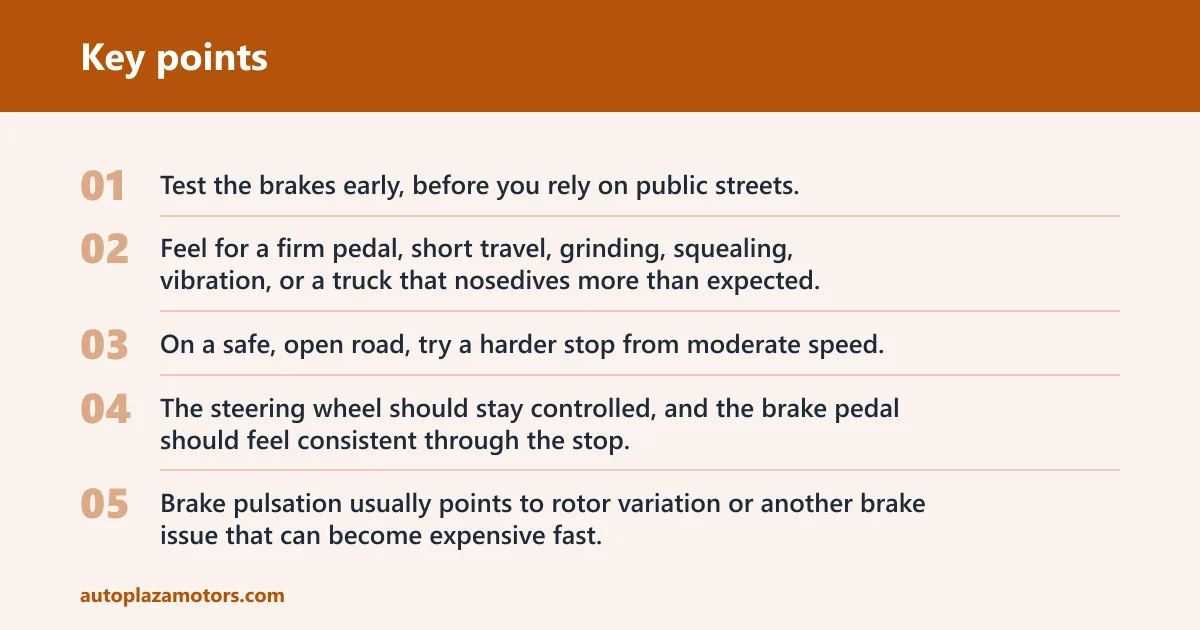
Test the brakes early, before you rely on public streets. Feel for a firm pedal, short travel, grinding, squealing, vibration, or a truck that nosedives more than expected.
On a safe, open road, try a harder stop from moderate speed. The steering wheel should stay controlled, and the brake pedal should feel consistent through the stop. Brake pulsation usually points to rotor variation or another brake issue that can become expensive fast.
Straight tracking and wheel centering
Keep both hands on the wheel, then make a brief, controlled check to see whether the truck tracks straight or pulls. Check wheel centering too; a wheel that sits off-center when the truck tracks straight can signal alignment or steering issues. A drift on a crowned road can be normal, but a constant pull on a flat road is not.
At full lock in a parking lot, listen for binding, clicking, or tire scrub that feels excessive. Trucks with oversized tires, lift kits, or worn front-end parts often show their worst behavior at slow speed and full steering angle.
Clunks, bounce, and chassis noise
Drive over bumps and broken pavement with the radio off. Keep the cabin quiet so you can listen, because truck cab insulation can mask problems until the road surface changes. Clunks, rattles, excessive body movement, and repeated rebounds suggest worn shocks, bushings, or ball joints.
Say a crew cab drives straight but gives one loud clunk when the front end drops into a pothole. That single sound can point to a worn suspension or chassis component, especially if it repeats over the next few bumps.
How to test towing, 4×4, and diesel behavior
Truck-specific checks matter here. Towing wear, transfer-case behavior, and diesel starting traits are easy to miss on a short loop, and those are exactly the systems that turn into large repairs after purchase. If the truck is built for work, pay attention to hitch condition, rear squat, temperature, and engagement quality under load.
-
Inspect tow gear.
Check the hitch, wiring, and trailer brake controller if equipped. Look for bent hardware, rust, hacked wiring, or signs the rear suspension has been overloaded, such as squat or sag. -
Test 4×4 operation.
If equipped, engage 2H normally, then test 4H and 4L only on a loose or low-traction surface where it is safe and appropriate. Watch for dash confirmation or indicator lights, then feel for binding, grinding, or failure to engage. If the truck fights steering on dry pavement in 4×4, that is often normal bind from using part-time 4WD on a high-traction surface, not necessarily a fault. -
Check diesel behavior.
On a diesel, note cold start quality, smoke, and idle stability before you drive away. Then watch the temperature gauge during sustained speed, because towing history and cooling problems matter more on diesel trucks that work hard.
If the truck has obvious towing hardware but the brake controller does nothing, the hitch is damaged, or the rear end sits noticeably low, treat that as a work-use warning, not a cosmetic issue. A truck that spent its life pulling loads needs a stricter inspection of cooling, brakes, and suspension.
Truck symptom decision table
Use this table as a quick map from symptom to likely repair bucket. It is most useful when you compare the road feel with where the problem shows up: cold start, highway speed, bumps, braking, turning, towing, or 4×4 engagement.
| Symptom observed | Likely cause | Severity | What to do next |
|---|---|---|---|
| Delay or clunk from Park to Drive | Transmission wear, driveline lash, or mount issues | Medium | Retest warm and cold; if it repeats, plan a scan and negotiate hard. |
| Shudder, slip, or flare on shifts | Transmission or torque-converter problem | High | Do not buy without a full inspection and fault-code check. |
| Grinding, squeal, pedal vibration | Brake wear, rotor issue, or hardware damage | Medium to high | Inspect pads, rotors, and calipers; use repair cost in negotiation. |
| Pull, drift, or off-center wheel | Alignment, tire wear, or steering wear | Medium | Check tire wear and front-end play before you proceed. |
| Clunks over bumps | Shocks, ball joints, bushings, or loose chassis parts | Medium to high | Have the front and rear suspension inspected before buying. |
| Temperature gauge climbs at speed | Cooling system weakness | High | Stop the drive, let it cool, and treat it as a major warning sign. |
| 4×4 will not engage or binds in use | Transfer-case, actuator, or driveline issue | High | Reject the truck unless a full repair history explains it clearly. |
| Rear squat, sag, or broken tow gear | Heavy towing use or worn suspension | Medium to high | Inspect frame, hitch, brakes, and rear springs carefully. |
| Diesel smoke, rough cold idle, long crank | Fuel, glow plug, injector, or compression issue | Medium to high | Verify service records and get a diesel-specific inspection. |
| Warning light clears, then returns | Stored fault that was reset | High | Scan the truck and treat the returning code as real, not cosmetic. |
Common mistakes
Many shoppers drive too short a route, stay on smooth roads, or accept a warm engine without noting that it can hide cold-start issues. Others listen for engine noise but forget the transmission, transfer case, brakes, and suspension are just as important on a truck.
- Skipping highway speed, which can hide shudder and cooling problems.
- Ignoring rough pavement, which can hide worn joints or loose parts.
- Accepting a dealer-only loop, which often avoids hard braking and full turns.
- Assuming a smooth idle proves the truck is sound.
- Missing warning lights that clear and return during the drive.
- Forgetting to compare the truck’s behavior with its likely use, such as towing, hauling, or off-road work.
A common first-timer mistake is to assume everything is fine because the truck feels quiet on a 3-minute lap around the block. A longer route with a merge, bump section, parking maneuver, and hard stop gives the drivetrain and chassis enough chance to show their weak points.
Frequently asked questions
How to test drive a used truck before you buy
Start cold, drive at least 20 minutes, and include a highway merge, a tight turn, rough pavement, and a braking stop. Turn off the radio and listen carefully, watch the temperature gauge, and note transmission shifts, steering feel, brake behavior, and any warning lights.
What should I check on a used truck during a test drive?
Check cold starting, idle quality, smoke, transmission engagement, shift quality, braking, steering centering, suspension noise, temperature stability, and dash lights. If the truck has 4×4, test engagement and look for binding or grinding.
How long should a used truck test drive be?
Plan for at least 20 minutes, and 30 minutes is a better target if you want time for city streets, highway speed, bumps, parking, and a brake check. Short drives miss the symptoms that show up only after the truck warms up.
What should I listen for on a used truck test drive?
Listen for clunks, rattles, axle whine, brake squeal, grinding, driveline lash, shudder on shifts, and changes in engine tone under load. Keep the cabin quiet so you can hear whether the noise happens at idle, over bumps, during braking, or at highway speed.
How do I test drive a used truck for towing?
Check the hitch, wiring, and brake controller if equipped, then look for rear squat or sag that suggests towing wear. During the drive, watch cooling, brake feel, and transmission behavior under load, because towing history often shows up there first.
What should I test in a used 4×4 truck drive?
If the truck is equipped for it, confirm 2H, 4H, and 4L engagement with dash confirmation or indicator lights. Then watch for binding, grinding, or failure to engage, especially during low-speed maneuvering and tight turns.
What does a bad transmission feel like on a test drive?
A bad transmission often shows delay from Park to Drive, harsh or lazy shifts, shudder, slipping, or a flare in engine speed without matching acceleration. If it happens under load or during a kickdown, treat it as a serious warning sign.
Can I refuse a test drive if the truck is already warm?
Yes. A warm engine can hide cold-start smoke, rough idle, and starting problems. Ask the seller to let the truck sit so you can inspect it from cold, and do not skip that request if you want a cleaner read on condition.